
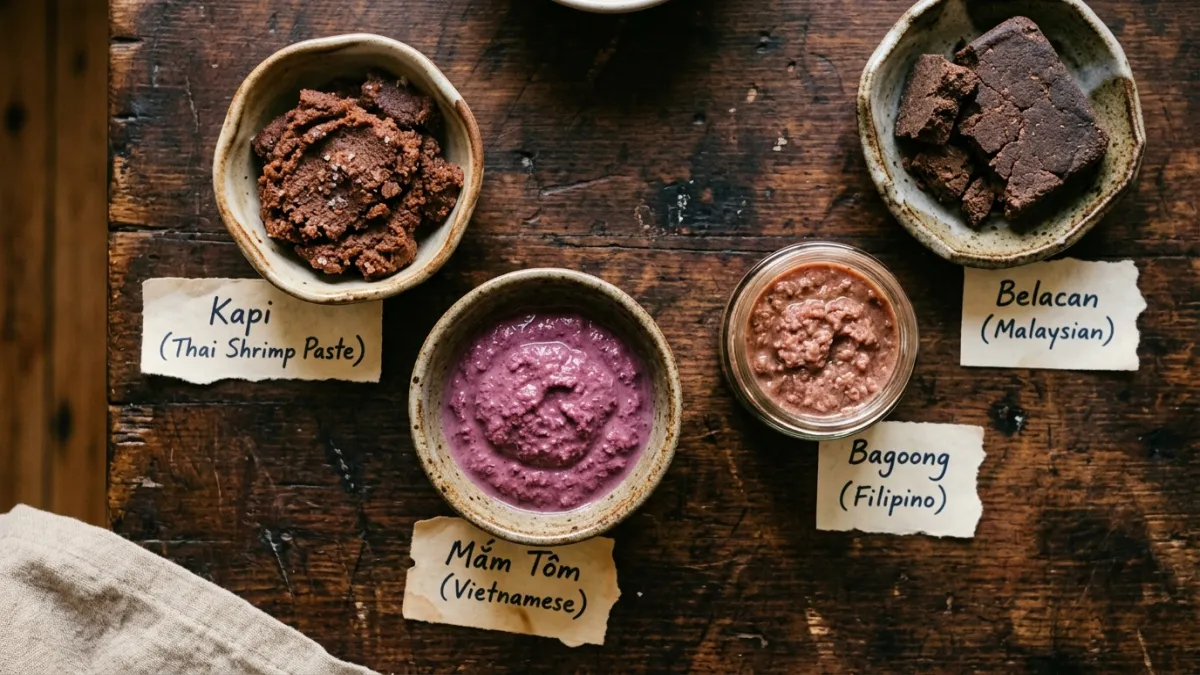
Picture ordering stir-fried vegetables in Kuala Lumpur because they seem safe. They’re not. The sambal underneath contains belacan — fermented shrimp paste — and nobody mentions it because nobody thinks of it as shellfish. Order a “vegetable” curry in Bangkok and the same problem has a different name: kapi. Order pinakbet in Manila — bagoong.
Shrimp paste goes by different names in every country — kapi (กะปิ) in Thailand, belacan in Malaysia, terasi in Indonesia, saeu-jeot (새우젓) in Korea, mam tom (mắm tôm) in Vietnam, bagoong in the Philippines, and xiājiàng (虾酱) in China. Across at least eight countries, it’s pounded into curry pastes, stirred into sambals, fermented into kimchi, and spooned onto condiment trays — all without appearing on any menu.
TL;DR: Fermented shrimp paste is in virtually every curry in Thailand, every sambal in Malaysia and Indonesia, most kimchi in Korea, and many condiment trays in Vietnam and the Philippines. Japan is the only major Asian destination without a shrimp paste tradition. Learn the local name, the avoidance phrase, and the escape-route restaurant type for each country before you go.
Why Is Shrimp Paste the Single Biggest Hidden Shellfish Danger for Travelers?
Because you can’t see it, smell it (once cooked), or taste it as a distinct ingredient. Shrimp paste is fermented and ground into a thick paste, then cooked into base sauces and curry pastes long before your dish is assembled. The finished plate contains crustacean protein with zero visual evidence.
According to a 2023 study in the Annals of Allergy, Asthma & Immunology, 68% of people with food allergies limit their vacation destinations — and 90% travel only domestically. Shrimp paste is a big reason why. According to the Mayo Clinic, shellfish allergy affects roughly 2% of the US population — about 6.5 million people — and unlike most food allergies, it’s far more common in adults: a PubMed systematic review found shellfish allergy prevalence in adults (2.5%) is 5x higher than in children (0.5%). The travelers most likely to encounter shrimp paste are the ones most likely to be allergic to it.
In Thailand alone, shrimp is the #1 confirmed food allergen, accounting for 40% of challenge-proven cases (Asian Pacific Journal of Allergy and Immunology, 2021). And the problem compounds across borders — there’s no universal name, no consistent labeling, and in most of these countries, restaurants have zero legal obligation to disclose it.
What Is Shrimp Paste Called in Every Country?
Every country that uses shrimp paste calls it something different and hides it in different dishes. Save this table to your phone before you travel.
| Country | Local Name | Script | Where It Hides | How to Say “No Shrimp Paste” |
|---|---|---|---|---|
| Thailand | Kapi | กะปิ | All curry pastes, nam phrik phao, tom yum base | ไม่ใส่กะปิ (Mai sai kapi) |
| Malaysia | Belacan | — | Sambal base, nasi lemak, rojak, laksa | Tanpa belacan |
| Indonesia | Terasi | — | Most sambals, nasi goreng, “vegetable” dishes | Tanpa terasi |
| Vietnam | Mam tom | Mắm tôm | Condiment trays, bun bo Hue broth | Không mắm tôm |
| Korea | Saeu-jeot | 새우젓 | Most kimchi, gyeran-jjim (steamed egg) | 새우젓 빼주세요 (Sae-u-jeot ppae-ju-se-yo) |
| Philippines | Bagoong | — | Kare-kare condiment, pinakbet, green mango dip | Walang bagoong |
| China | Xiājiàng | 虾酱 | XO sauce, dried shrimp in congee, chili oil | 不要虾酱 (bùyào xiājiàng) |
| Myanmar | Ngapi | — | Many curries and dipping sauces | Limited data — proceed with caution |
A Frontiers in Allergy meta-analysis (2025) found that shellfish allergy affects 0.5–2.5% of the global population. In Southeast Asian countries where shrimp paste is foundational, prevalence runs even higher: 5.12% among teens in the Philippines and 5.23% in Singapore (PMC/Frontiers, 2022).
Which Countries Are Hardest to Navigate With a Shellfish Allergy?
Malaysia and Indonesia are the hardest — close to impossible if you’re eating local Malay or Indonesian food. Thailand is nearly as bad because every traditional curry contains kapi. Japan is the most manageable major Asian destination because it has no shrimp paste tradition at all.
| Difficulty | Countries | Why |
|---|---|---|
| 5/5 — Nearly impossible | Malaysia, Indonesia | Belacan/terasi is in the sambal base used in hundreds of dishes. Even “vegetable” dishes use it. |
| 4–5/5 — Very difficult | Thailand | Kapi is in ALL traditional curry pastes. Tom yum base contains dried shrimp. |
| 4/5 — Difficult | Vietnam, Philippines | Mam tom on condiment trays (Vietnam). Bagoong in vegetable dishes and as a side condiment (Philippines). |
| 3/5 — Moderate | Korea, China | Saeu-jeot is implicit in most kimchi (Korea). Oyster sauce is default on stir-fried vegetables in China — worst in Cantonese cuisine. Shrimp-specific IgE prevalence reaches 13.1% in China’s Shaoguan region (PMC, 2022). |
| 2/5 — Manageable | Japan | No shrimp paste tradition. Main risks are surimi (contains crab extract) and shrimp/crab in specific dishes like takoyaki and okonomiyaki. |
There’s a universal trap worth flagging: the “vegetable dish” pattern. In China, stir-fried vegetables get oyster sauce by default. In Thailand, “vegetable” curries use standard curry paste with kapi. In Indonesia, “vegetable” dishes use sambal terasi. In the Philippines, the classic vegetable dish pinakbet is seasoned with bagoong. Ordering vegetables does not mean ordering shellfish-free.
Where Can You Find Safe Restaurants in Each Country?
Every country on this list has an escape route — a restaurant type that avoids shrimp paste by default.
| Country | Safe Restaurant Type | Why It Works |
|---|---|---|
| Thailand | Jay (เจ) restaurants | Buddhist vegan — no animal products, no fish sauce, no shrimp paste |
| Malaysia | Mamak (Indian Muslim) restaurants | Indian cooking doesn’t use belacan. Roti canai, thosai, biryani are usually shellfish-safe |
| Vietnam | Chay restaurants | Buddhist vegan — same concept as Thai jay restaurants |
| Korea | Temple food (사찰음식) restaurants | Traditional Buddhist cuisine, no fermented seafood |
| Indonesia | Tourist restaurants in Bali | Best allergy awareness in the country due to tourism volume |
| China | Any restaurant — but say 不要蚝油 | No single safe category, but explicitly requesting no oyster sauce on every vegetable dish eliminates the biggest trap |
Tools like Menu Decoder can scan local-language menus and flag shrimp paste variants automatically — but knowing these restaurant types before you arrive is your first line of defense.
Does Fermentation Destroy Shrimp Allergens?
No. Fermentation reduces the allergenic potential of shrimp protein, but it does not eliminate it. A 2022 study published in Food Chemistry (PMID 35969990) found that tropomyosin — the primary protein responsible for crustacean allergic reactions — showed an average 56.3% reduction in IgE-binding capacity after fermentation into terasi. That means roughly half the allergenic activity remained.
This is why some people react to fresh shrimp but tolerate shrimp paste, or vice versa. Individual sensitivity thresholds vary. But “reduced” is not “safe,” and according to a 2023 survey in the Annals of Allergy, Asthma & Immunology, more than 50% of restaurant staff surveyed believed that allergy patients could safely eat small amounts of their allergen. That misconception is dangerous enough with fresh ingredients — with fermented products where staff don’t even realize shrimp is present, it compounds.
As FARE (Food Allergy Research & Education) advises: “Travelers with food allergies should carry translated allergy cards and verify ingredients directly with kitchen staff, not front-of-house servers.” That advice doubles in importance when the ingredient is a paste that went into the dish twenty minutes before it reached your table. If you have a confirmed shellfish allergy, treat all fermented shrimp products as unsafe regardless of fermentation duration or processing method.
What About Oyster Sauce, Fish Sauce, and XO Sauce?
Oyster sauce is a mollusk allergen, fish sauce is a fish allergen, and XO sauce contains both crustacean and mollusk allergens. They’re often lumped together as “Asian sauces,” but they trigger completely different allergic reactions — and knowing which is which can mean the difference between a safe meal and an ER visit.
| Sauce | Made From | Allergen Type | Extra Trap |
|---|---|---|---|
| Oyster sauce (蚝油, háoyóu) | Oyster extract | Mollusk (not crustacean) | Most Thai and Chinese brands use wheat flour as thickener — so it also carries a gluten allergen |
| Fish sauce (น้ำปลา / nước mắm) | Fermented anchovies | Fish (not crustacean or mollusk) | Generally safe for shellfish-only allergy, but cross-contamination risk in shared kitchens |
| XO sauce (XO酱) | Dried scallops + dried shrimp | Both mollusk AND crustacean | Premium Cantonese sauce — shellfish IS the product |
| Shrimp paste (kapi/belacan/terasi) | Fermented shrimp/krill | Crustacean | The base of curry pastes and sambals — invisible in finished dishes |
One critical language trap in China: 贝类 (bèilèi) means mollusks only — clams, mussels, oysters. It does not cover shrimp or crab. If your allergy is crustacean-based, you need to say 不要贝类和虾蟹 (bùyào bèilèi hé xiā xiè) — “no shellfish AND no shrimp/crab.” Using only 贝类 leaves you exposed to the exact ingredients you’re trying to avoid.
In Korea, a similar issue exists: saeu-jeot (새우젓, fermented shrimp) is crustacean, while myeolchi-aekjeot (멸치액젓, anchovy fish sauce) is fish. Many kitchens use them interchangeably, so specifying “no crustacean” alone isn’t reliable. Use the broader term jeotgal (젓갈) — “no fermented seafood” — to cover both: 젓갈 빼주세요 (jeotgal ppae-ju-se-yo).
Frequently Asked Questions
Can you eat shrimp paste if you have a shellfish allergy?
You should not. Shrimp paste is made from fermented shrimp or krill — both crustaceans — and contains tropomyosin, the protein that triggers crustacean allergic reactions. While fermentation reduces IgE-binding capacity by roughly 56% according to a 2022 Food Chemistry study, that still leaves significant allergenic potential. The reduction varies by product: some traditional preparations retain more protein than others, and individual sensitivity thresholds differ. Some people with mild shellfish sensitivity may tolerate small amounts of heavily fermented paste, but there’s no reliable way to predict who will react and who won’t. If you’ve been diagnosed with a shellfish allergy — especially one involving anaphylaxis — treat all shrimp paste products (kapi, belacan, terasi, saeu-jeot, mam tom, bagoong) as unsafe. The fact that the shrimp has been fermented does not make it a different allergen.
Is fish sauce safe for people with shellfish allergies?
Usually, yes. Fish sauce (nam pla in Thai, nước mắm in Vietnamese) is made from fermented anchovies or other small fish — it’s a fish product, not a crustacean product. If your allergy is specifically to crustaceans (shrimp, crab, lobster), fish sauce is generally not a problem. However, there are two caveats. First, some cheaper fish sauce brands may include shrimp in the fermentation process — check labels where available. Second, cross-contamination is common in Asian kitchens where fish sauce, shrimp paste, and oyster sauce are all used at the same station. Shared woks are rarely cleaned between orders. If you have both fish AND shellfish allergies, fish sauce is extremely dangerous — it’s concentrated fish protein in virtually every savory dish. For fish allergy specifically, jay (เจ) or chay restaurants replace fish sauce with soy sauce entirely.
What is the difference between belacan, kapi, terasi, and bagoong?
They’re all fermented shrimp paste — the same concept adapted to different cuisines. Kapi (Thailand) and belacan (Malaysia) are the most similar: dense, dark, pungent blocks of fermented shrimp. Terasi (Indonesia) is essentially the same product as belacan — the languages are closely related. Bagoong (Philippines) is usually wetter and comes in jars rather than blocks, and there’s an important distinction: bagoong alamang is fermented shrimp (crustacean allergen), while bagoong isda is fermented fish (different allergen profile). Saeu-jeot (Korea) is salted fermented whole shrimp rather than a ground paste. Mam tom (Vietnam) is a purple-pink paste served as a condiment, often alongside bun dau. From an allergen perspective, they’re all crustacean products. The processing differs, the potency varies, but the core risk is the same: tropomyosin protein from shrimp.
Does fermentation destroy shellfish allergens?
Not completely. Fermentation does reduce the allergenic potency of shrimp-derived products, but “reduced” is not “eliminated.” A 2022 Food Chemistry study found that tropomyosin IgE-binding activity dropped by an average of 56.3% during terasi production — meaning roughly half the allergenic potential survived the fermentation process. The degree of reduction likely varies depending on fermentation method, duration, temperature, and the specific shrimp species used. This is why some individuals with shellfish allergy can tolerate fermented shrimp paste without reaction while others cannot — it depends on where their personal threshold falls relative to the reduced protein level. There is currently no standardized testing to tell you whether a specific batch of shrimp paste falls above or below your threshold. The safe assumption for anyone with a diagnosed shellfish allergy is to treat fermented products as still allergenic.
How do you tell a restaurant about a shellfish allergy in Southeast Asia?
Name the specific ingredients, not the allergy category. “No shellfish” is too vague in most Asian languages — it may be interpreted as “no whole shrimp on the plate” while shrimp paste stays in the curry. Instead, name every hidden form: “no shrimp paste, no dried shrimp, no oyster sauce.” Use the avoidance phrases from the shrimp paste table above, and show them to kitchen staff — not servers. In Thailand: ไม่ใส่กะปิ, ไม่ใส่กุ้ง, ไม่ใส่น้ำมันหอย (no shrimp paste, no shrimp, no oyster sauce). In Malaysia: tanpa belacan, tanpa udang (no shrimp paste, no shrimp). Carry a printed allergy card in the local language — or better yet, both a card and a menu-scanning app so you can verify dishes before ordering. Speaking directly to the cook — not just the server — is critical, since last-second additions of shrimp paste or oyster sauce happen at the wok, not the order counter.
This guide is for informational purposes and does not constitute medical advice. Always consult your allergist about your specific triggers and thresholds, and verify ingredients directly with restaurant kitchen staff before eating.
Related guides: For country-specific deep dives, see our guides to eating safely with food allergies in Thailand and Japan. If you’re managing multiple allergens, our peanut allergy country-by-country guide covers another invisible ingredient that overlaps with shrimp paste risk in Thailand and Indonesia. And if you’re curious about insect cross-reactivity — yes, chapulines (grasshoppers) share the same tropomyosin protein — see our Mexico food allergy guide.