
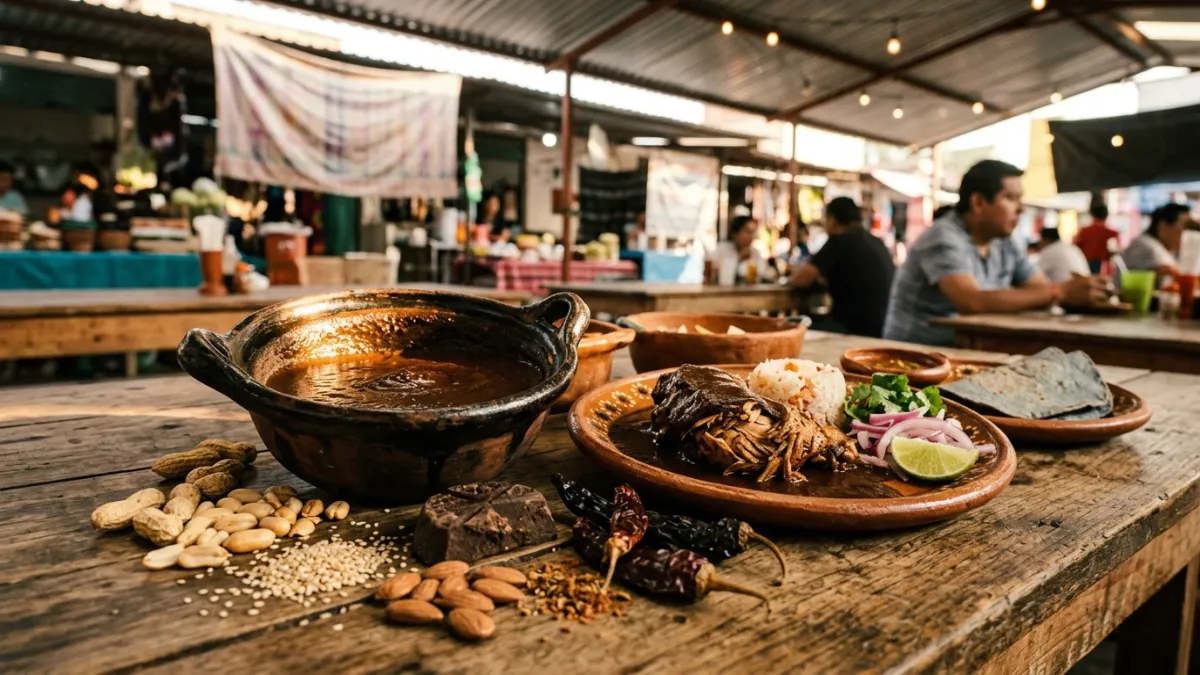
You’re at a restaurant in Oaxaca. The chicken in mole negro looks incredible. The sauce is a smooth, dark paste. Nothing about its appearance suggests what’s inside: peanuts, almonds, walnuts, pecans, sesame seeds, bread, chocolate, and lard. That’s six major allergen categories in a single spoonful.
Mole negro is likely the most allergen-dense sauce preparation in any cuisine. A single serving can contain peanuts, three types of tree nuts, sesame, wheat (from bread used as thickener), and chocolate, all ground together until nothing is individually identifiable. Not all moles carry the same risk. Oaxaca’s seven traditional moles range from very high allergen loads to relatively low ones.
TL;DR: Mole negro contains peanuts, tree nuts (almond, walnut, pecan), sesame, wheat (bread thickener), chocolate, and lard. The safer Oaxacan moles are amarillo, verde, and chichilo, which use masa instead of bread and skip the nuts and sesame. But any kitchen making mole negro also makes the lower-risk varieties on the same surfaces, so cross-contamination is near-certain.
This article is for informational purposes. If you have food allergies, consult your doctor before making dietary changes. Restaurant conditions vary, and no guide can guarantee safety.
How Many Allergens Does Mole Sauce Actually Contain?
More than almost any other single preparation you’ll encounter while traveling. According to the FDA, nine major food allergens account for roughly 90% of all food-allergic reactions in the US. Mole negro hits five or six of those nine in one dish: peanuts, tree nuts, sesame, wheat, and milk (when finished with dairy). According to FARE (Food Allergy Research & Education), food allergy reactions account for 200,000 emergency department visits per year in the US alone. Most of those reactions involve a single allergen. Mole stacks them. The sauce typically contains 20 to 30 ingredients ground together into a smooth paste, which means you cannot see, smell, or taste any individual component. For a traveler with even one of the major allergies, mole is a dish where visual inspection tells you nothing.
What Are the 7 Moles of Oaxaca and Which Are Safest?
The seven traditional moles split into two clear tiers by allergen risk. The high-risk moles (negro, poblano/rojo, coloradito) use nuts, sesame, and bread as core ingredients. The lower-risk moles (amarillo, verde, chichilo) thicken with masa or corn tortillas instead and skip the nuts and sesame entirely.
| Mole Variety | Peanut | Tree Nut | Sesame | Wheat (Bread) | Chocolate | Lard | Risk Level |
|---|---|---|---|---|---|---|---|
| Negro | Yes | Almond, walnut, pecan | Yes | Yes | Yes | Yes | VERY HIGH |
| Poblano / Rojo | Yes | Almond | Yes | Sometimes | Yes | Yes | HIGH |
| Coloradito | No | Almond | Yes | Yes (breadcrumbs) | Yes | Yes | HIGH |
| Amarillo | No | No | No | No (masa thickened) | No | Yes | LOW |
| Verde | No | No | No | No | No | Yes | LOW |
| Chichilo | No | No | No | No (masa/tortilla) | No | Yes | LOW |
| Manchamanteles | Varies | Varies | Varies | Varies | No | Yes | MODERATE |
Manchamanteles is fruit-based and recipe-dependent, so ask about ingredients individually. The critical point: even the low-risk moles carry cross-contamination risk from shared kitchen surfaces (see next section). According to the ACAAI, 30-35% of peanut-allergic individuals also react to tree nuts, compounding the danger in any kitchen preparing multiple mole varieties.
Why Is Cross-Contamination Almost Guaranteed in Mole Kitchens?
Because mole is a paste, and paste gets everywhere. Traditional mole preparation uses grinding stones (metates) or large blenders to reduce 20-30 ingredients into a smooth sauce. Peanut, sesame, and tree nut particles coat every grinding surface. When the same equipment processes mole amarillo (technically nut-free), residue from yesterday’s mole negro transfers directly. Commercial kitchens that serve multiple mole varieties rarely dedicate separate equipment to each one. The economics don’t justify it when only a small fraction of diners have allergies. According to a PMC study (2024), 50% of allergic reactions at restaurants involve hidden allergens in preparations the diner never sees. Mole kitchens concentrate this risk because the allergen isn’t in the dish you ordered. It’s on the surface that touched every dish.
What About Oaxacan Chocolate Shops?
The same cross-contamination logic applies, and it extends beyond restaurants. Oaxacan chocolate shops grind cacao on the same metates used for mole ingredients. Travelers with nut or sesame allergies may not connect “chocolate shop” with “nut-grinding facility,” but that’s exactly what these shops are. Traditional Oaxacan chocolate (chocolate de mesa) is typically dairy-free: cacao, sugar, cinnamon, and sometimes almonds. Even batches made without almonds carry residue from batches that included them. According to the Annals of Allergy, Asthma & Immunology (2023), 82.3% of food-allergic travelers reported experiencing an allergic reaction while abroad. Souvenir chocolate from shared-equipment shops is an easy way to join that statistic. If you have a nut or sesame allergy, treat any chocolate ground on shared equipment as contaminated.
What Other Mexican Sauces Contain Hidden Allergens?
Mole isn’t the only sauce that hides allergens. Several popular Mexican sauces use nuts, seeds, or wheat in ways that aren’t obvious from the name alone.
| Sauce | Key Allergens | What It Is |
|---|---|---|
| Encacahuatado | Peanut (primary ingredient) | Peanut sauce, sometimes just called “salsa” |
| Pipian / Pepian | Pumpkin seed, often peanut, sometimes sesame | Seed-based sauce, sometimes labeled as “mole” |
| Salsa macha | Peanut + sesame fried in oil | Condiment served alongside chips or bread |
| Nogada (as in chiles en nogada) | Walnut cream + cheese | Seasonal (Aug-Sep), walnut is the sauce |
Mexico has no legal requirement for restaurants to disclose allergens on menus. COFEPRIS regulates packaged food labeling under NOM-051, but restaurant menus are unregulated. For the full picture of safe and risky Mexican dishes by allergy type, see How Do You Eat Safely With Food Allergies in Mexico?
How Do You Order Safely Around Mole in Mexico?
Talk to the cook (cocinero), not the waiter (mesero). Mexican kitchens are often open or semi-visible, so walk up and communicate directly. Allergy awareness varies widely. Staff in Mexico City tourist areas will understand “alergia,” but in Oaxacan fondas, the concept may not register as a medical emergency.
| Phrase | Spanish | Pronunciation |
|---|---|---|
| Does this have peanuts? | Esto lleva cacahuates? | ES-toh YEH-vah kah-kah-WAH-tays? |
| Does this have sesame? | Esto lleva ajonjoli? | ES-toh YEH-vah ah-hohn-hoh-LEE? |
| Does this have nuts? | Esto lleva nueces? | ES-toh YEH-vah NWEH-ses? |
| I have a severe allergy | Tengo una alergia grave | TEN-goh OO-nah ah-LER-hee-ah GRAH-veh |
| Which mole has no peanuts? | Cual mole no lleva cacahuates? | KWAHL MOH-leh noh YEH-vah kah-kah-WAH-tays? |
Carry a printed allergy card in Mexican Spanish. Pair it with a way to check the menu before the conversation starts. Menu Decoder handles the scanning part, flagging dishes that likely contain your allergens, but always confirm directly with the cook.
Which Mexican Dishes Are Always Mole-Free?
Several Mexican staples never involve mole or its allergen-heavy relatives. If you’re navigating nut, sesame, or wheat allergies in Mexico, these dishes keep you on solid ground.
Safe alternatives include tacos al pastor (pork, pineapple, corn tortilla), carne asada tacos, cochinita pibil (slow-roasted pork with achiote and citrus), pozole (hominy soup), ceviche (for non-seafood allergies), and grilled meats with fresh salsas. Street taquerias are actually an advantage since you can watch every ingredient go in. According to FARE (2024), 68% of food-allergy patients limit their vacation destinations entirely due to allergy fears. Mexico doesn’t need to be on that list if you know which sauces to avoid. Stick to grilled proteins, corn tortillas, and fresh salsas. Say “sin crema, sin queso” (no cream, no cheese) to block uninvited dairy garnish. For a full breakdown by allergy type, see How Do You Eat Safely With Food Allergies in Mexico?
Frequently Asked Questions
Does mole sauce contain peanuts?
It depends on the variety. Mole negro and mole poblano traditionally include peanuts (cacahuates) as a core ingredient, along with tree nuts and sesame. Mole de cacahuate is literally named “peanut mole.” But mole amarillo, mole verde, and mole chichilo typically contain no peanuts at all, using masa (corn dough) as their thickener instead. The problem: when a menu simply says “mole” without specifying the variety, you have no way of knowing which one you’re getting. Some restaurants label peanut mole simply as “mole.” Many traditional recipes include peanuts, though some regional variations substitute other nuts or seeds. Always ask “Cual mole es?” (which mole is it?) and then follow up with “Lleva cacahuates?” (does it contain peanuts?). Even if the specific mole is peanut-free, cross-contamination from other mole preparations in the same kitchen remains a concern.
Which mole is safest for nut allergies?
Mole amarillo and mole chichilo are your best options. Both are thickened with masa (corn dough) or corn tortillas rather than nuts or bread. Mole verde uses herbs and pumpkin seeds as its base. None of these three typically contain peanuts, tree nuts, or sesame. Amarillo gets its yellow color from chilhuacle amarillo chilies, not from any nut-based ingredient. However, “safest” is relative. According to the ACAAI, 30-35% of peanut-allergic individuals also react to tree nuts, and any Oaxacan kitchen making multiple moles grinds everything on shared surfaces. The safest approach: ask if the restaurant makes mole negro or mole poblano. If they do, assume every grinding surface carries nut and sesame residue. For severe allergies, consider whether the cross-contamination risk is acceptable even with a technically nut-free mole.
Is mole gluten-free?
Many moles are not. Mole negro, mole poblano, and mole coloradito traditionally use stale bolillo bread (wheat) as a thickener, creating hidden gluten that even gluten-aware travelers miss. The bread is ground into the paste and completely invisible in the finished sauce. Mole amarillo, mole verde, and mole chichilo use masa (corn) or corn tortillas instead of bread, making them naturally gluten-free by recipe. But cross-contamination applies here too, since the same equipment processes wheat-containing and wheat-free moles. According to NIH data, sesame allergy affects approximately 0.23% of the US population, and sesame became the 9th major US food allergen under the FASTER Act in 2023. If you’re managing celiac disease alongside other allergies, Oaxacan mole kitchens are particularly challenging. For a parallel example of hidden wheat in sauces, see What Is the Asafoetida Gluten Trap in Indian Food?
Can you eat mole with a sesame allergy?
This is extremely difficult. Sesame seeds (ajonjoli) appear in mole negro, mole poblano, mole coloradito, and many pipian recipes. Sesame is toasted before grinding, intensifying the protein that triggers reactions. Among the seven Oaxacan moles, only amarillo, verde, and chichilo are typically sesame-free. According to NIH data, approximately 1.5 million Americans have a sesame allergy. Sesame became the 9th major US food allergen under the FASTER Act on January 1, 2023, reflecting growing recognition of its severity. In Mexico, sesame isn’t treated as a major allergen and restaurant staff may not think to mention it. The word to use is “ajonjoli” (ah-hohn-hoh-LEE). Ask specifically: “Esto lleva ajonjoli?” Don’t ask about “sesame,” since the English word won’t register in a Mexican kitchen.
What is mole negro made of?
Mole negro is the most complex of Oaxaca’s seven moles. A traditional recipe typically includes: dried chilhuacle negro chilies (charred), mulato chilies, pasilla chilies, peanuts (cacahuates), almonds (almendras), walnuts (nueces de Castilla), pecans (nueces pecanas), sesame seeds (ajonjoli), stale bolillo bread, Mexican chocolate, plantain, tomatoes, tomatillos, onion, garlic, oregano, thyme, cloves, cinnamon, black pepper, cumin, and lard. That’s 20-30 ingredients, with six or more falling into major allergen categories. The sauce is ground on a metate or in a blender until completely smooth, meaning you cannot identify any individual ingredient by sight, smell, or taste. It takes days to prepare and is considered the pinnacle of Oaxacan cuisine. For allergen purposes, treat it as containing every major allergen except egg and fish.
How do you ask about mole ingredients in Spanish?
Start with the specific mole variety: “Cual mole es?” (KWAHL MOH-leh es?) means “Which mole is it?” Then ask about your specific allergens using “Esto lleva…?” (ES-toh YEH-vah), which means “Does this contain…?” This phrasing is more natural in Mexican Spanish than “contiene.” Key allergen terms: cacahuates (peanuts), ajonjoli (sesame), nueces (nuts/walnuts), almendras (almonds), pan (bread/wheat). Always direct these questions at the cook (cocinero), not the waiter. According to FARE, verifying ingredients with kitchen staff rather than front-of-house servers is more reliable. A printed allergy card in Mexican Spanish is your strongest tool. Include the phrase “No es preferencia, es una condicion medica” (this isn’t a preference, it’s medical). Menu Decoder can scan the menu and flag likely allergen-containing dishes before you start the conversation, but always confirm with the kitchen directly.