
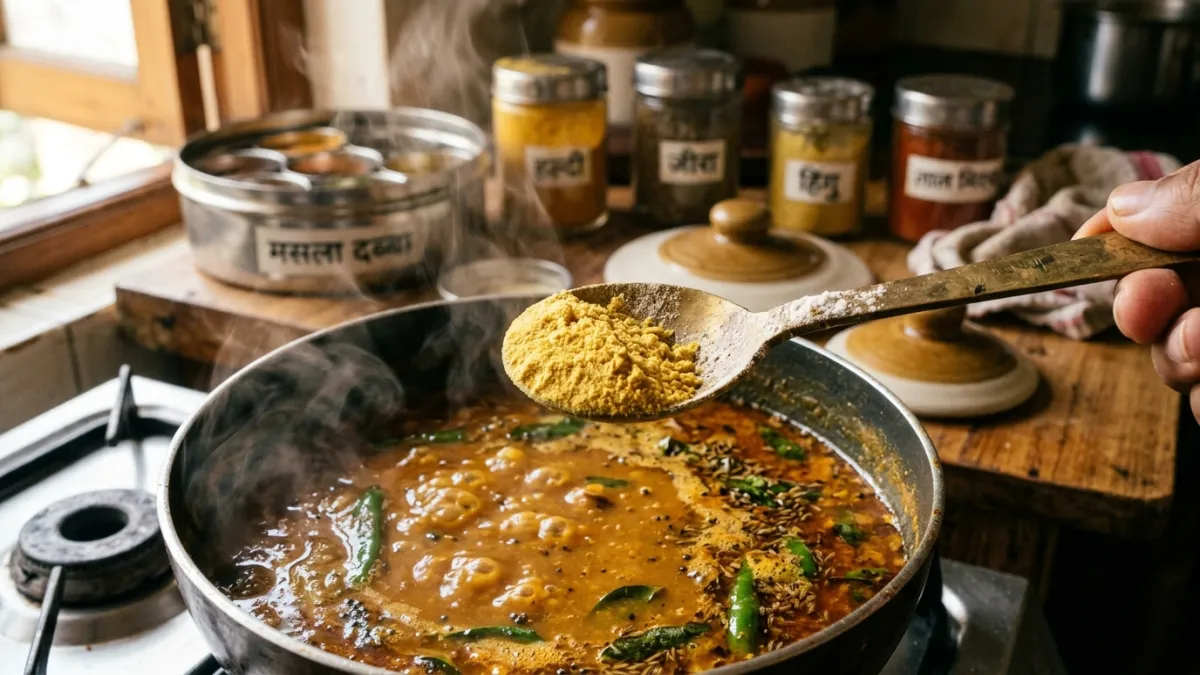
You’re sitting in a restaurant in Delhi, scanning the menu for something safe. Dal seems perfect. Lentils, spices, served over rice. No wheat listed anywhere. But one of those “spices” is asafoetida (hing), and it’s almost certainly 50-70% wheat flour by weight.
Over 90% of commercial hing powder sold in India is compounded with wheat flour. If you have celiac disease or a wheat allergy, that “simple” dal just became a gluten delivery system. The same ingredient hides in virtually every lentil dish, most vegetable preparations, and the bulk-prepared tadka (tempering) that gets ladled across half the menu. It won’t be listed separately. The kitchen doesn’t think of it as a wheat product. And most restaurant staff have no idea it contains gluten.
TL;DR: Pure asafoetida resin is naturally gluten-free, but the powdered hing in Indian kitchens is typically 50-70% wheat flour. It’s in nearly every dal and many vegetable dishes. South Indian restaurants are your safest option. Ask “Kya heeng mein gehun hai?” (क्या हींग में गेहूँ है?) and bring your own gluten-free hing if possible.
This article is for informational purposes. If you have celiac disease or a wheat allergy, consult your doctor before making dietary changes. Restaurant situations vary, and no guide can guarantee safety.
Why Does Hing Contain Wheat Flour?
Pure asafoetida is a gum resin tapped from the roots of Ferula plants. It’s naturally gluten-free, intensely pungent, and expensive to produce in quantity. Manufacturers cut it with wheat flour for two practical reasons: to prevent the sticky resin from clumping, and to stretch a costly ingredient further. According to the National Institute of Food Technology, Entrepreneurship and Management (NIFTEM), a typical commercial hing composition is roughly 60% wheat flour, 15% asafoetida resin, and 25% gum arabic. Some products push the wheat content even higher. The economics are simple. Wheat flour is cheap filler that also works as an anti-caking agent, so producers use it liberally. Rice-flour-based alternatives exist but cost more and are harder to find in mainstream Indian markets. For someone without celiac disease, none of this matters. For someone with it, that pinch of hing transforms every dal on the menu.
How Much Gluten Does a Pinch of Hing Add to Your Dal?
More than enough to trigger a reaction. A typical tadka uses roughly 0.5 grams of hing powder. If that powder is 60% wheat flour, you’re getting about 0.3 grams of wheat flour per serving of dal. The FDA defines “gluten-free” as less than 20 parts per million (ppm). A single serving of dal made with standard hing blows past that threshold by orders of magnitude. This is a rough estimate, not a lab measurement, but the direction is clear: standard hing is not borderline. It’s firmly in the “contains gluten” category.
| Hing Amount | Wheat Content (at 60%) | Equivalent Wheat Flour | vs. FDA 20 ppm Threshold |
|---|---|---|---|
| 0.25g (light pinch) | 0.15g | ~150 mg | Far exceeds |
| 0.50g (standard tadka) | 0.30g | ~300 mg | Far exceeds |
| 1.0g (heavy hand) | 0.60g | ~600 mg | Far exceeds |
The short version: don’t try to calculate a safe threshold. If the hing isn’t verified gluten-free, skip the dal. According to Singh et al. in Clinical Gastroenterology and Hepatology (2018), celiac disease affects roughly 1.4% of the global population by serological screening. For any of those people eating dal in India, hing is the invisible problem.
Which Indian Dishes Contain Hing?
Nearly every lentil-based dish and many vegetable preparations. Hing goes into the tadka, the hot oil tempering that’s the foundation of most Indian cooking. Cooks often prepare tadka in bulk and ladle it across multiple dishes, meaning one batch of wheat-containing hing contaminates everything it touches.
| Dish | Hindi Name | Contains Hing? | Gluten Risk |
|---|---|---|---|
| Dal tadka (tempered lentils) | दाल तड़का | Almost always | High |
| Dal makhani | दाल मखनी | Almost always | High |
| Sambhar | सांभर | Almost always | High |
| Rasam | रसम | Usually | High |
| Chana masala | छोले / चना मसाला | Often | Moderate-High |
| Aloo gobi (potato-cauliflower) | आलू गोभी | Often | Moderate |
| Mixed vegetable sabzi | सब्ज़ी | Often | Moderate |
| Biryani | बिरयानी | Sometimes | Low-Moderate |
| Plain tandoori meats | तंदूरी | Rarely | Low |
| Dosa / Idli | डोसा / इडली | No | Low (check accompaniments) |
The trap runs deeper than individual dishes. Because tadka is a bulk preparation, asking “does this dish have hing?” often gets a confused look. The cook may not consider hing a separate ingredient any more than you’d consider salt one.
Is South Indian Food Safer for Celiac Travelers?
Significantly. South Indian cuisine is built on rice and coconut rather than wheat and dairy. Dosa, idli, uttapam, and appam are all rice-and-lentil-based, naturally gluten-free, and widely available. The regional difference in celiac risk is dramatic. According to Makharia et al. at AIIMS New Delhi (Journal of Gastroenterology and Hepatology, 2011), celiac prevalence in North India is 1.23% compared to just 0.10% in the South. Mean daily wheat intake tells the story: 455 grams per day in the North versus 25 grams in the South.
South Indian restaurants still use hing in sambhar and rasam, so you’re not completely in the clear. But the base cuisine is rice, and coconut oil replaces ghee in most preparations. Chains like Saravana Bhavan are your best bet anywhere in India for gluten-conscious dining. The catches: peanut chutney is served alongside dosa without announcement, and rava dosa (रवा डोसा) is made from wheat semolina despite having “dosa” in the name. For the full regional breakdown, see How Do You Eat Safely With Food Allergies in India?
How Do You Ask About Hing in Hindi and Tamil?
Talk to the cook, not the waiter. This can feel intimidating, especially if you don’t speak Hindi, but Indian restaurant kitchens are often open or semi-visible, and a printed allergy card bridges the language gap. According to a Sussex University study, 60% of Indian food service staff believe water “dilutes” allergens during a reaction. Allergy awareness varies wildly, and the waiter may not know what hing is made from. The cook is more likely to understand the question, even if they can’t answer definitively.
| Phrase | Hindi (Devanagari) | Romanization |
|---|---|---|
| Does the hing have wheat? | क्या हींग में गेहूँ है? | Kya heeng mein gehun hai? |
| I am allergic to wheat | मुझे गेहूँ से एलर्जी है | Mujhe gehun se allergy hai |
| No hing please | हींग मत डालिए | Heeng mat daaliye |
| I have a wheat allergy (Tamil) | எனக்கு கோதுமை ஒவ்வாமை உள்ளது | Enakku godhumai ovvaamai ulladhu |
| No hing please (Tamil) | பெருங்காயம் வேண்டாம் | Perungaayam vendaam |
A printed allergy card in Hindi gets you further than verbal communication in a loud kitchen. For scanning an unfamiliar menu before you start the conversation, Menu Decoder can flag dishes likely to contain wheat-based hing, though you should always confirm directly with the kitchen.
What Are the Gluten-Free Alternatives to Standard Hing?
Gluten-free hing exists. The pure resin is naturally wheat-free. The problem is that most commercial grinding processes default to wheat flour as the carrier. Several brands now use rice flour instead. Pure Indian Foods sells a rice-flour-based organic hing. Deep brand offers a gluten-free compounded hing. Burlap & Barrel sells wild-harvested asafoetida resin that’s single-ingredient, no filler at all. All three are available online. If you’re traveling to India with celiac disease, bringing your own small container of verified gluten-free hing is a practical move. You can ask the restaurant to use yours instead of theirs. It’s an unusual request, but most Indian kitchens are flexible about ingredient substitutions when the reason is clear. The taste is identical since the flavor comes from the resin, not the filler. Label-reading tip: look for “rice flour” or “gluten-free” on the ingredient list. If the label just says “wheat flour, asafoetida, gum arabic,” that’s the standard version.
What Other Hidden Gluten Sources Exist in Indian Food?
Hing is the sneakiest gluten source, but it’s not the only one. Several popular Indian dishes contain wheat in ways that aren’t obvious from the menu description. Rava dosa (रवा डोसा) is the classic example. The name sounds like a dosa, which is rice-based and gluten-free. But rava means semolina, which is wheat. Suji halwa (सूजी हलवा) is another semolina trap. Jalebi batter is wheat flour. Some papad varieties use wheat flour instead of the traditional urad dal or rice flour. And every naan, roti, paratha, and bhatura is wheat-based, though those are more obvious.
Cross-contamination adds another layer: shared tawa griddles cook wheat roti and rice dosa back to back, shared deep-fry oil handles samosas (wheat) and pakora (usually besan, but cross-contaminated), and tandoor ovens drip naan residue onto meats cooking below. For the broader picture of hidden wheat in Asian condiments, see Does Soy Sauce Have Wheat?. For a country comparison, see Which Countries Are Easiest and Hardest for Celiac Disease Travelers?
Frequently Asked Questions
Is asafoetida (hing) gluten-free?
The pure resin is, yes. Asafoetida in its raw form is a gum tapped from Ferula plant roots, and it contains no wheat. The problem is that over 90% of the commercial hing powder sold in India and abroad is compounded with wheat flour as an anti-caking agent and cost-cutting filler. A typical commercial product is 60% wheat flour, 15% asafoetida resin, and 25% gum arabic, according to processing guides from the National Institute of Food Technology (NIFTEM). If you have celiac disease, treat any unlabeled hing powder as containing wheat unless you can verify the ingredients. Gluten-free alternatives using rice flour are available from brands like Pure Indian Foods, Deep, and Burlap & Barrel. When eating at restaurants in India, assume the hing contains wheat and ask specifically: “Kya heeng mein gehun hai?” (क्या हींग में गेहूँ है?).
How much gluten is in a typical serving of dal made with hing?
Enough to cause a reaction in anyone with celiac disease. A standard tadka preparation uses approximately 0.5 grams of hing powder per serving. If that hing is 60% wheat flour, that’s about 0.3 grams (300 milligrams) of wheat flour in your dal. The FDA gluten-free threshold is less than 20 parts per million. A single serving of dal with standard hing exceeds that threshold by a wide margin. This is a rough calculation, not a laboratory measurement, so the exact amount varies by cook and recipe. But the takeaway is clear: this is not a borderline case. Celiac travelers should avoid dal made with standard hing entirely rather than trying to calculate safe thresholds.
Can you eat South Indian food with celiac disease?
South Indian cuisine is your safest bet in India, but it’s not automatically safe. The base is rice rather than wheat: dosa, idli, uttapam, and appam are all naturally gluten-free. Coconut oil and coconut milk replace ghee and dairy cream in many preparations. According to Makharia et al. (AIIMS New Delhi), celiac prevalence in South India is just 0.10% versus 1.23% in the wheat-heavy North, reflecting how little wheat the traditional southern diet contains. The catches: sambhar and rasam usually contain hing, which means wheat. Rava dosa is semolina (wheat) despite having “dosa” in the name. And peanut chutney accompanies most meals automatically. Stick to plain dosa, idli, or appam, confirm the hing source, and skip anything with “rava” or “suji” in the name.
How do you ask if hing contains wheat in Hindi?
The phrase is “Kya heeng mein gehun hai?” (क्या हींग में गेहूँ है?), which translates literally to “Does the hing have wheat?” Direct this at the cook, not the waiter. Most front-of-house staff won’t know the composition of the hing their kitchen uses. In Tamil-speaking South India, ask “Perungaayam la godhumai irukka?” (பெருங்காயத்தில் கோதுமை இருக்கா?). According to a Sussex University/PMC study, 60% of Indian food service staff believe water dilutes allergens, so be direct and specific with your question. Don’t ask “is this gluten-free?” since that concept doesn’t translate directly into Hindi kitchen vocabulary. Name the specific ingredient (hing) and the specific concern (wheat). Bringing a printed card in Hindi with your allergies listed is more reliable than verbal communication alone.
What brands sell gluten-free asafoetida?
Three widely available options use rice flour or no filler at all. Pure Indian Foods makes an organic asafoetida compounded with rice flour instead of wheat, available on their website and Amazon. Deep brand produces a gluten-free hing powder, also available online and at Indian grocery stores. Burlap & Barrel sells wild-harvested asafoetida resin with no filler, meaning it’s single-ingredient and naturally gluten-free. If you’re traveling to India with celiac disease, pack a small container of verified gluten-free hing. You can hand it to the cook and ask them to use it in place of their standard hing. It’s an unusual request, but Indian kitchens are generally flexible when the reason involves a medical condition.
Does cooking destroy gluten in hing?
No. Gluten proteins are heat-stable and survive normal cooking temperatures. Boiling, frying, or simmering hing in a tadka does not break down or reduce the wheat protein content. This is the same reason baked bread still contains gluten. According to FARE (Food Allergy Research & Education), no amount of cooking makes a gluten-containing ingredient safe for someone with celiac disease. The only solution is to use hing that was never compounded with wheat in the first place, or to skip hing entirely. If a restaurant tells you “the wheat cooks out” or “it’s just a tiny amount,” neither statement is accurate for celiac disease. Even trace amounts of gluten trigger the autoimmune response in celiac patients.