
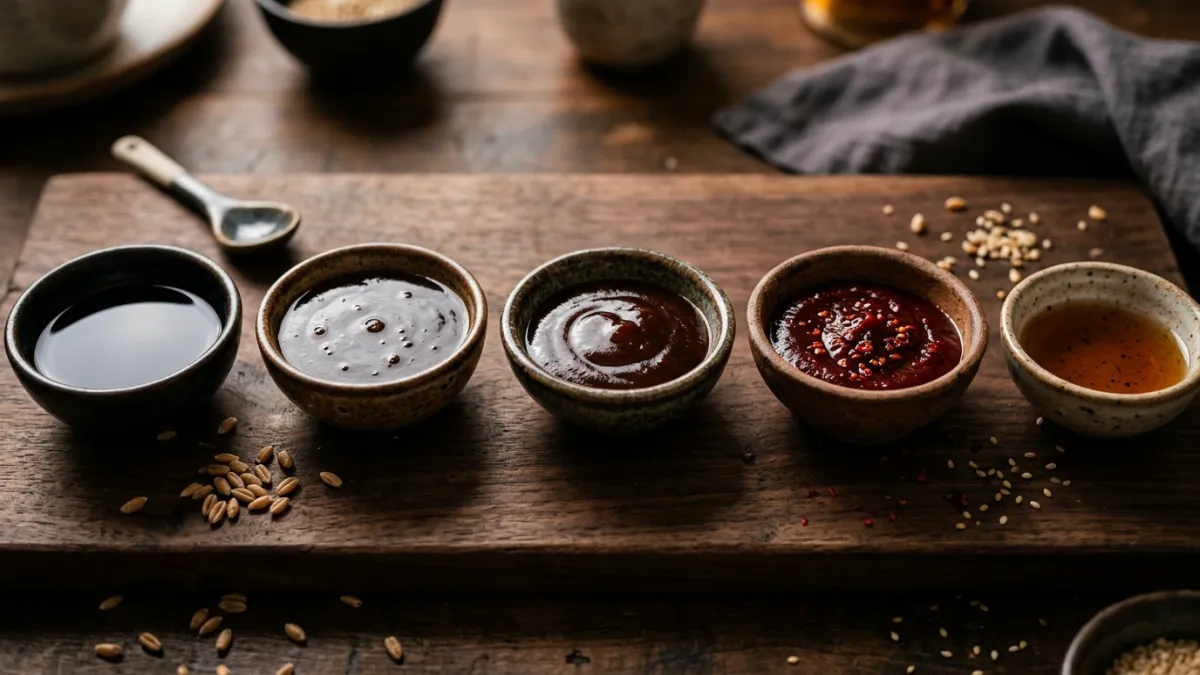
Yes. Standard soy sauce is brewed from roughly 50% wheat. That makes it one of the most common hidden gluten sources in Asian cooking. But soy sauce is just the start. Oyster sauce, hoisin, Shaoxing wine, gochujang, and dozens of other staple condiments also contain wheat, often without any obvious label warning.
TL;DR: Most Asian soy sauce is about half wheat. But the real danger is the dozens of other condiments (oyster sauce, hoisin, Shaoxing wine, doubanjiang, kecap manis) that also contain hidden wheat. Fish sauce, coconut aminos, and verified wheat-free tamari are the most reliable gluten-free alternatives.
This article is for informational purposes. If you have celiac disease or a wheat allergy, consult your doctor before making dietary changes based on this content. Restaurant situations vary, and no guide can guarantee safety.
Why Do So Many Asian Sauces Contain Hidden Wheat?
Because wheat is a deliberate brewing ingredient, not an accidental additive. In soy sauce production, wheat is roasted, cracked, and combined with soybeans before fermentation. The wheat starches break down into sugars that feed the fermenting cultures, creating the complex flavor profile that makes soy sauce taste like soy sauce. Around 80% of all soy sauce consumed in Japan is koikuchi (dark soy sauce), brewed from approximately 50% wheat (Kikkoman production data).
The same fermentation logic applies across the condiment shelf. Doubanjiang uses wheat flour in its paste. Shaoxing wine uses a wheat-based fermentation starter called maiqu (麦曲). Sweet flour sauce, tiánmiànjiàng (甜面酱), is literally named after its primary ingredient: wheat flour. The pattern repeats because wheat is cheap, effective at driving fermentation, and produces desirable umami depth. Celiac disease affects roughly 1.4% of the global population based on serologic testing (Singh et al., 2018, Gastroenterology). According to the Annals of Allergy, Asthma & Immunology, 30% of food-allergic travelers experienced allergic reactions during trips abroad, with restaurants as the primary cause. For this population, Asian condiment aisles are a minefield.
“Travelers with food allergies should carry translated allergy cards and verify ingredients directly with kitchen staff, not front-of-house servers.” — FARE (Food Allergy Research & Education)
Which Asian Condiments Contain Wheat or Gluten?
The table below maps the most common wheat-containing condiments across Asian cuisines. Standard soy sauce gets the attention, but several of these are more surprising.
| Condiment | Local Name(s) | Cuisines | Wheat Source | Gluten-Free Alternative |
|---|---|---|---|---|
| Soy sauce (standard) | 酱油 jiàngyóu (CN), 醤油 shōyu (JP), 간장 ganjang (KR), ซีอิ๊ว si-ew (TH) | All Asian | ~50% wheat in brewing | Tamari (wheat-free brands), coconut aminos |
| Oyster sauce | 蚝油 háoyóu (CN), น้ำมันหอย nam man hoi (TH) | Chinese, Thai, SE Asian | Wheat flour thickener | Mushroom sauce (verify label) |
| Shaoxing wine | 绍兴酒 Shàoxīng jiǔ | Chinese | Wheat-based starter (麦曲) | Dry sherry (most are GF) |
| Doubanjiang | 豆瓣酱 dòubànjiàng | Chinese (Sichuan) | Wheat flour in paste | Chili flakes + salt (not equivalent) |
| Hoisin sauce | 海鲜酱 hǎixiān jiàng | Chinese, Vietnamese | Wheat flour + soy | No direct substitute |
| Sweet flour sauce | 甜面酱 tiánmiànjiàng | Chinese (Beijing) | Wheat flour is primary ingredient | None |
| Kecap manis | Kecap manis | Indonesian, Malaysian | Soy + wheat (most brands) | Coconut aminos + palm sugar |
| Dark soy sauce | ซีอิ๊วดำ si-ew dam (TH) | Thai, Chinese | Wheat + soy | Wheat-free tamari |
| Gochujang | 고추장 gochujang | Korean | Soy + often wheat in commercial brands | Homemade or certified GF brands |
| Doenjang | 된장 doenjang | Korean | Commercial versions often add wheat flour | Traditional homemade (soy-only) |
| Miso (barley) | 麦味噌 mugi-miso | Japanese | Barley koji (gluten) | Mame-miso or Hatcho-miso (soy-only) |
| Japanese curry roux | カレールー | Japanese | Wheat flour thickener | Curry powder + rice flour roux |
| Teriyaki / ponzu / tonkatsu | Various | Japanese | All soy-sauce-based | Gluten-free soy sauce base |
Standard soy sauce contains 0.5 to 3% gluten concentration (Gluten Free Watchdog). That is well above the 20 parts per million (ppm) threshold for “gluten-free” labeling in most countries.
What About Sauces That Sound Safe but Aren’t?
Three condiments consistently catch travelers off guard.
Shaoxing wine is labeled “rice wine” on English menus and in many grocery stores. It is not rice-only. The fermentation starter, maiqu (麦曲), is wheat-based. Most Shaoxing wine bottles do not list wheat on the label because allergen labeling standards vary by country. China’s updated GB 7718-2025 standard will make allergen labeling mandatory for prepackaged foods covering eight allergens including wheat, but it does not take effect until March 2027 (China NHC/SAMR).
Oyster sauce is a double allergen trap. It contains both shellfish (oyster extract) and wheat flour as a thickener. Someone managing celiac disease might check for wheat but not expect it in an oyster-derived product. Someone with a shellfish allergy might avoid it for the oyster but not realize the wheat is also there.
Hoisin sauce translates literally to “seafood sauce” (海鲜酱), but it contains no seafood. It is made from soybeans, wheat flour, sugar, and spices. The misleading name can cause confusion in both directions: people with shellfish allergies may avoid it unnecessarily, while people with wheat allergies may assume a “seafood sauce” is wheat-free. According to FARE, food allergy reactions send someone to the emergency room roughly every 3 minutes in the United States (FARE). Misleading condiment names contribute to that risk abroad.
Which Asian Cuisines Are Hardest for Gluten Avoidance?
Not all Asian food cultures present equal risk. Rice-based cuisines with fish sauce traditions are significantly safer than wheat-heavy northern regions. The ranking below reflects both the baseline diet and condiment reliance.
| Region | Difficulty | Key Factors |
|---|---|---|
| Northern China | Extreme | ~80% wheat-based diet. Soy sauce, Shaoxing wine, and sweet flour sauce in nearly every dish. Noodles and dumplings are wheat-default. |
| Japan | Very Hard | Soy sauce is in virtually everything. Wheat in curry roux, panko, fu (wheat gluten), udon. Read the full Japan allergy guide. |
| Korea | Hard | Ganjang, doenjang, and gochujang all contain or may contain wheat. Shared cooking surfaces are standard. |
| Indonesia | Moderate-Hard | Kecap manis is in nearly every stir-fry. Rice base helps, but the sweet soy sauce is unavoidable in most dishes. |
| Southern China | Moderate | Rice-based diet, but oyster sauce, soy sauce, and hoisin appear in most stir-fries and dim sum. |
| Thailand | Moderate | Rice-based with fish sauce as primary seasoning. But soy sauce and oyster sauce appear in stir-fries. Read the full Thailand allergy guide. |
| Vietnam | Easier | Fish sauce (usually gluten-free) replaces soy in many dishes. Rice noodles are the default starch. Closest to “safe by default” in the region. |
Roughly 38% of travelers with food allergies experienced an allergic reaction while abroad, according to a 2023 study in the Journal of Travel Medicine. The cuisine’s baseline difficulty level directly affects those odds. For a broader look at which countries are hardest for gluten avoidance, see the celiac country ranking guide.
What Are the Safest Gluten-Free Alternatives?
Four condiments reliably replace the wheat-containing staples. None are perfect one-to-one substitutes, but they cover the core flavor needs. According to the Celiac Disease Foundation, roughly 1 in 133 Americans has celiac disease, many undiagnosed, and safe condiment alternatives are essential for this population when cooking or traveling.
| Alternative | Gluten-Free? | Soy-Free? | Flavor Profile | Watch Out For |
|---|---|---|---|---|
| Tamari (wheat-free) | Usually, but verify label | No | Closest to standard soy sauce, richer | Some brands add small amounts of wheat. Look for “gluten-free” certification. |
| Coconut aminos | Yes | Yes | Milder, slightly sweet | Lower sodium, thinner body. Not identical to soy sauce. |
| Fish sauce | Yes (usually) | Yes | Pungent, salty, umami | A few brands add hydrolyzed wheat protein. Check label. |
| Rice vinegar | Yes | Yes | Tangy, light acidity | Seasoned rice vinegar sometimes adds soy sauce. Use unseasoned. |
Tamari is the most commonly recommended substitute, but it comes with a critical caveat: tamari is not automatically gluten-free. Some brands, particularly in Japan, include small amounts of wheat in the brewing process. Always look for explicit “gluten-free” labeling or third-party certification. Coconut aminos work well for anyone avoiding both gluten and soy, though the flavor is noticeably milder and sweeter than soy sauce. Roughly 0.4% of the world’s population has a wheat allergy distinct from celiac disease (World Allergy Organization), so gluten-free labeling alone may not address all wheat-related conditions.
How Do You Communicate a Wheat Allergy at an Asian Restaurant?
Knowing the risky condiments is half the problem. The other half is communicating your needs to kitchen staff who may not share your language or your framework for understanding allergies.
The most reliable approach combines two things: a physical allergy card in the local language to show kitchen staff, and a way to verify the menu before you even start the conversation. I built Menu Decoder for the scanning part. You photograph the menu and it flags dishes based on your specific allergy profile. But the card is equally important, because the kitchen staff making your food may never see the menu.
Here are key phrases for the most common situations:
| Language | ”I cannot eat wheat/gluten" | "Does this contain soy sauce?” |
|---|---|---|
| Mandarin | 我不能吃小麦/面筋 (wǒ bù néng chī xiǎomài/miànjīn) | 这个有酱油吗?(zhège yǒu jiàngyóu ma?) |
| Japanese | 小麦が食べられません (komugi ga taberaremasen) | 醤油は入っていますか?(shōyu wa haitte imasu ka?) |
| Korean | 밀을 못 먹습니다 (mir-eul mot meokseumnida) | 간장이 들어있나요? (ganjang-i deureo-innayo?) |
| Thai | ฉันกินข้าวสาลีไม่ได้ (chan gin khao sali mai dai) | มีซีอิ๊วไหม? (mee si-ew mai?) |
Be aware that shared woks can retain up to 20mg of allergenic protein after rinsing (Sharma et al., 2020, Journal of Allergy and Clinical Immunology). Even if the dish itself is safe, cross-contact from the cooking surface is a real risk. Requesting a clean wok is reasonable at sit-down restaurants. At street food stalls, the risk is higher and harder to control. Tools like Menu Decoder can help you identify which dishes on a menu are likely to contain these sauces before ordering, but no tool can account for kitchen cross-contact, so the allergy card and direct communication remain essential.
What Else Do People Ask About Wheat in Asian Sauces?
Does soy sauce actually contain wheat?
Yes. Standard soy sauce is brewed from a roughly equal mix of soybeans and wheat. This is not a trace amount or cross-contamination issue. Wheat is a core ingredient in the brewing process, where it provides the sugars that fermentation cultures need to produce soy sauce’s characteristic flavor. Standard soy sauce contains between 0.5 and 3% gluten concentration, well above the 20 ppm threshold that most countries use for “gluten-free” labeling. The wheat is partially broken down during fermentation, which is why some people with mild sensitivities report tolerating soy sauce. But for anyone with celiac disease, the gluten levels in standard soy sauce are not safe. Tamari brewed without wheat, coconut aminos, or certified gluten-free soy sauce are the alternatives.
Is fish sauce gluten-free?
In most cases, yes. Traditional fish sauce is made from fish and salt, fermented over months. It contains no wheat, barley, or rye. This makes it one of the safest umami sources in Asian cooking for people avoiding gluten. However, a small number of commercial brands add hydrolyzed wheat protein or other wheat-derived ingredients as flavor enhancers. Always check the ingredient label, particularly on budget brands. In Southeast Asian countries like Vietnam and Thailand, fish sauce (น้ำปลา, nam pla in Thai; nước mắm in Vietnamese) is the dominant seasoning, which is one reason those cuisines tend to be easier for gluten avoidance than Chinese or Japanese food. When eating out, confirm with the restaurant that their fish sauce is a pure fish-and-salt product. The World Allergy Organization estimates that 0.4% of the global population has a wheat allergy distinct from celiac disease, so even trace wheat additives in fish sauce matter.
Which Asian country is hardest to visit with celiac disease?
Northern China presents the most extreme difficulty. The regional diet is approximately 80% wheat-based, with noodles, dumplings, steamed buns, and flatbreads forming the foundation of most meals. Soy sauce, Shaoxing wine, and sweet flour sauce appear in nearly every savory dish. Japan ranks second due to the near-universal presence of soy sauce. Even dishes that appear simple, like sashimi, are typically served with wheat-containing soy sauce. Celiac disease prevalence has increased 5-fold in American children since the 1980s (Gastroenterology), making this a growing concern for traveling families. Vietnam is generally the easiest option, with fish sauce as the default seasoning and rice noodles as the standard starch. Southern China (Cantonese cuisine) is easier than the north because rice is the base starch, though oyster sauce and soy sauce still appear in most stir-fries.
What is the difference between tamari and soy sauce for gluten avoidance?
Tamari is a Japanese-style soy sauce traditionally brewed with little or no wheat, compared to standard soy sauce which uses roughly 50% wheat. This makes wheat-free tamari a popular substitute for people with celiac disease or wheat allergies. The critical distinction: not all tamari is wheat-free. Some Japanese tamari brands include small amounts of wheat in their brewing process. You need to look for bottles explicitly labeled “gluten-free” or carrying third-party certification. Flavor-wise, tamari tends to be darker, thicker, and slightly richer than standard soy sauce. It works as a direct substitute in most recipes. Coconut aminos offer a soy-free and gluten-free alternative, but with a noticeably milder, sweeter flavor that does not replicate soy sauce as closely as tamari does.
Does oyster sauce contain gluten?
Usually, yes. Most commercial oyster sauce contains wheat flour as a thickener alongside the oyster extract, sugar, and salt. This makes oyster sauce a double allergen concern: it contains both shellfish (oyster) and wheat. Some brands produce wheat-free versions, but they are not widely available in Asian grocery stores or restaurant kitchens. Oyster sauce is a staple in Chinese, Thai, and broader Southeast Asian cooking, appearing in stir-fries, vegetable dishes, and marinades. When eating at restaurants, asking about oyster sauce specifically is important because kitchen staff may not think of it as a “wheat” product. In Thai cooking, oyster sauce (น้ำมันหอย, nam man hoi) is the finishing touch on most stir-fries, including pad kra pao. Mushroom-based sauces can sometimes substitute for oyster sauce in home cooking, but always verify that the mushroom sauce itself is wheat-free, as some brands use similar thickeners.