
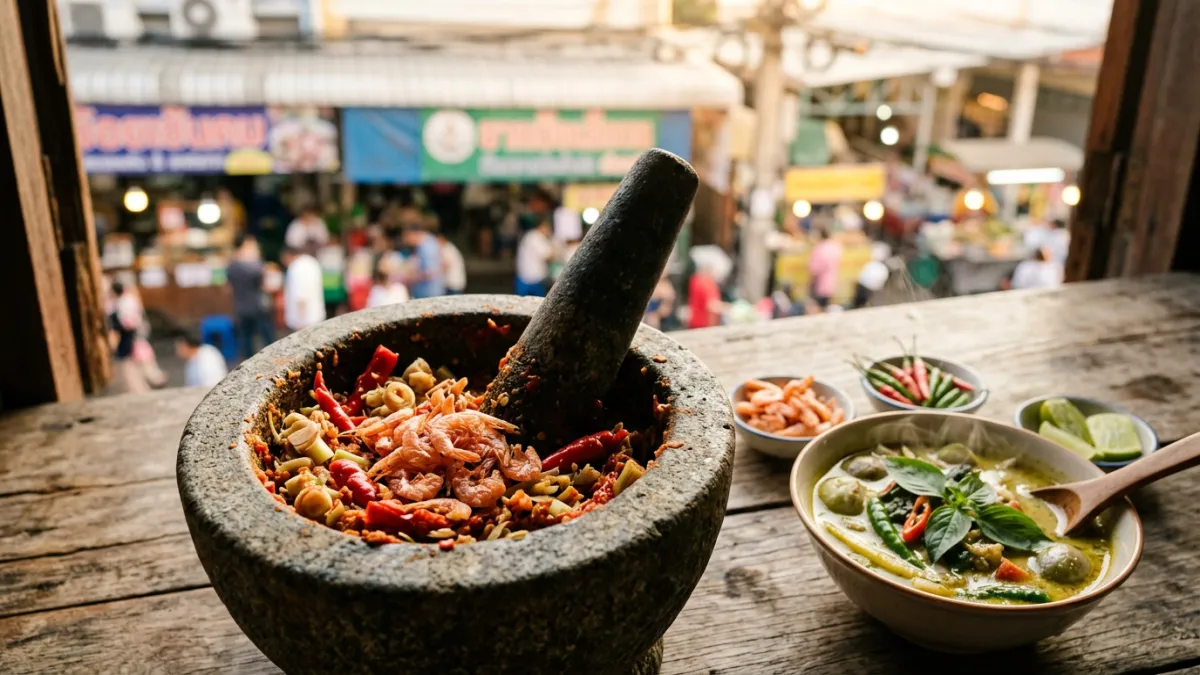
You ordered green curry with chicken, no shrimp. But the curry paste itself contains kapi, a fermented shrimp paste that’s been ground into every Thai curry since before the dish had a name. Skipping the shrimp topping does nothing. The shellfish is already inside the paste, the stir-fry sauce, and the soup base. Thai cuisine uses crustacean and mollusk ingredients as foundational seasonings, not optional additions.
TL;DR: Shrimp paste (kapi) is in every standard Thai curry paste. Oyster sauce is in most stir-fries. Nam phrik phao (roasted chili paste) loads tom yum and tom kha with dried shrimp. Even “chicken” or “vegetable” versions contain shellfish through these base ingredients. Jay (เจ) vegan restaurants are your safest option.
This article is for informational purposes. If you have a shellfish allergy, consult your doctor before making dietary changes. Restaurant situations vary, and no guide can guarantee safety.
Why Does Every Thai Curry Contain Shellfish?
Every standard Thai curry paste uses kapi (กะปิ), a pungent fermented paste made from shrimp or krill. Green, red, yellow, panang, massaman, jungle. All of them. Even a “vegetable” curry at most restaurants starts with the same paste. The kapi gets pounded into the base along with chilies, lemongrass, galangal, and garlic, making it impossible to remove or reduce after the fact.
This matters because shrimp is the number one confirmed food allergen in Thailand, responsible for 40% of positive oral food challenges in a hospital-based study at Siriraj Hospital (Asia Pacific Allergy, 2018). Shellfish allergy prevalence runs between 0.5% and 2.5% globally, with confirmed rates reaching up to 0.9% and the highest concentrations found in Southeast Asia (Frontiers in Allergy, 2022).
| Curry | Thai Name | Contains Kapi? | Other Shellfish Risk |
|---|---|---|---|
| Green curry | แกงเขียวหวาน (gaeng khiao wan) | Yes | Fish sauce (usually safe) |
| Red curry | แกงแดง (gaeng daeng) | Yes | Fish sauce |
| Yellow curry | แกงกะหรี่ (gaeng karee) | Yes | Fish sauce |
| Panang curry | แกงพะแนง (gaeng phanaeng) | Yes | Fish sauce |
| Massaman curry | แกงมัสมั่น (gaeng matsaman) | Yes | Fish sauce, peanuts |
| Jungle curry | แกงป่า (gaeng pa) | Yes | Fish sauce |
Southern Thailand uses the heaviest concentrations of kapi. If you’re traveling south toward Phuket, Krabi, or Hat Yai, expect shrimp paste in places you wouldn’t see it in Bangkok. For the broader picture of eating safely in Thailand, see How Do You Eat Safely With Food Allergies in Thailand?
What Is Nam Phrik Phao and Why Is It in Everything?
Nam phrik phao (น้ำพริกเผา), the roasted chili paste that gives tom yum its distinctive color and depth, is triple-loaded with shellfish. It contains dried shrimp, shrimp paste (kapi again), and fish sauce. This paste is the base of both tom yum (ต้มยำ) and tom kha (ต้มข่า), Thailand’s two most famous soups.
Here’s the correction that catches most travelers off guard: ordering tom yum with chicken (ต้มยำไก่) or mushroom does not make it shellfish-free. The crustacean is in the soup base, not the protein topping. A study in the Annals of Allergy (2023) found that 50% of restaurant allergen incidents involved a “hidden” allergen in sauces or pastes. Tom yum is that statistic in a bowl.
The same paste shows up in pad thai variations, fried rice, and some dipping sauces. Any dish with a slightly sweet, smoky chili flavor likely has nam phrik phao in it.
Which Thai Stir-Fries Contain Hidden Shellfish?
Oyster sauce (น้ำมันหอย, nam man hoi) is a mollusk-derived condiment present in pad kra pao (ผัดกระเพรา), pad see ew (ผัดซีอิ๊ว), Thai fried rice (ข้าวผัด), and virtually every stir-fry coming out of a Thai wok. Pad kra pao is Thailand’s most popular street food, and it’s built on oyster sauce.
An important distinction: oyster sauce is a mollusk allergen, not a crustacean allergen. Some people allergic to shrimp and crab tolerate mollusks. But if your allergy is broadly classified as “shellfish,” oyster sauce is a risk. According to Frontiers in Allergy (2022), 45.2% of food-induced anaphylaxis cases in Thailand are attributed to shellfish. That figure doesn’t distinguish between crustacean and mollusk triggers, which underscores the need to know your specific allergy profile.
| Dish | Thai Name | Hidden Shellfish Ingredient | Allergen Type |
|---|---|---|---|
| Basil stir-fry | ผัดกระเพรา (pad kra pao) | Oyster sauce | Mollusk |
| Stir-fried noodles | ผัดซีอิ๊ว (pad see ew) | Oyster sauce | Mollusk |
| Thai fried rice | ข้าวผัด (khao pad) | Oyster sauce | Mollusk |
| Papaya salad (Thai) | ส้มตำไทย (som tam Thai) | Dried shrimp, fish sauce | Crustacean |
| Papaya salad (Isan) | ส้มตำปู (som tam pu) | Raw fermented crab | Crustacean |
| Tom yum (any protein) | ต้มยำ (tom yum) | Nam phrik phao (dried shrimp + kapi) | Crustacean |
| Tom kha (any protein) | ต้มข่า (tom kha) | Nam phrik phao (dried shrimp + kapi) | Crustacean |
Most Thai oyster sauce brands also use wheat flour as a thickener. If you’re managing both a shellfish allergy and celiac disease, oyster sauce is a double hit. For more on hidden wheat in Asian condiments, see Does Soy Sauce Have Wheat?
Is Fish Sauce Safe for a Shellfish Allergy?
Generally, yes. Nam pla (น้ำปลา) is made from fermented fish, not crustaceans. For someone with a shellfish-only allergy, fish sauce is usually not a trigger. It’s in almost everything in Thai cuisine, so this is good news.
The caveat: some fish sauce brands include shrimp in their ingredient list. Check the label if you’re buying a bottle, and ask the restaurant if you’re eating out. “Check the label for crustacean ingredients” is the practical advice here, since specific brand formulations change.
Thailand’s food allergy incidence has increased 3-4x over recent decades (Bangkok Post, 2024), which means awareness is growing but still uneven. A restaurant cook in Bangkok is more likely to understand your concern than one in a small town, but neither is guaranteed to know the exact brand of fish sauce in their kitchen. For the global picture of where shrimp paste hides in other cuisines, see Where Does Shrimp Paste Hide in World Cuisines?
What Can You Safely Eat in Thailand With a Shellfish Allergy?
Plenty, if you know where to look. Grilled meats are your best friends: moo ping (หมูปิ้ง, grilled pork skewers), gai yang (ไก่ย่าง, grilled chicken), and sai krok Isan (ไส้กรอกอีสาน, Isan sausage) are typically marinated without shellfish-based sauces. Pair them with sticky rice (ข้าวเหนียว) and you have a full meal.
Fresh fruit is everywhere and obviously safe. Mango sticky rice (ข้าวเหนียวมะม่วง) uses coconut milk, sugar, and rice. No shellfish involved.
Jay (เจ) vegan restaurants use no animal products at all, which eliminates kapi, oyster sauce, fish sauce, and dried shrimp in one move. These restaurants are marked with yellow flags bearing a red เจ symbol. They operate year-round in most Thai cities and become ubiquitous during the Vegetarian Festival in October. This is the highest-confidence option for someone with a severe shellfish allergy.
For scanning Thai menus before you sit down, Menu Decoder can flag dishes likely to contain hidden shellfish ingredients. Though you should always confirm directly with the kitchen.
How Do You Communicate a Shellfish Allergy in Thai?
Talk to the cook, not the waiter. This applies in Thailand just as much as anywhere else. The person preparing your food is the one who knows what goes into the wok. According to the Annals of Allergy (2023), 74% of allergen-related food incidents happen in restaurants, not from packaged food. Verbal communication with the right person matters.
The essential phrase: “Mai sai kapi” (ไม่ใส่กะปิ) means “don’t add shrimp paste.” For full coverage, use the longer version:
| Phrase | Thai Script | Romanization |
|---|---|---|
| No shrimp paste | ไม่ใส่กะปิ | Mai sai kapi |
| I’m allergic to shrimp, crab, shrimp paste, oyster sauce | ผม/ฉันแพ้กุ้ง ปู กะปิ น้ำมันหอย ไม่ใส่ครับ/ค่ะ | Phom/Chan pae kung, pu, kapi, nam man hoi. Mai sai khrap/kha. |
| If I eat shrimp I will die | ถ้ากินกุ้งจะตาย | Tha gin kung ja tai |
That last phrase sounds dramatic, but it communicates severity in a way that “I’m allergic” sometimes doesn’t.
A printed allergy card in Thai gets you further than pronunciation alone. One critical caveat: wok cross-contamination is unavoidable at most street stalls. Woks are seasoned, not soaped between uses. Even if the cook skips the kapi for your dish, residue from the previous stir-fry remains. For anyone with a history of anaphylaxis, street food woks are a higher-risk environment. For how this compares to peanut risks in Thai cooking, see Can You Eat Thai Food With a Peanut Allergy?
Does Thailand Require Allergen Labeling in Restaurants?
No. Thailand’s allergen labeling regulation (Notification No. 450, 2024) covers packaged food products only. There is no legal requirement for restaurants or street vendors to disclose allergens on menus or signage. This is a gap that affects travelers directly. According to the Annals of Allergy (2023), 30% of food-allergic travelers experienced an allergic reaction while traveling, and food allergy prevents 14% of allergic persons from traveling abroad entirely.
Without restaurant labeling, the burden falls on you. Knowing which base ingredients contain shellfish, communicating in Thai, and choosing restaurants strategically are the only defenses available. Since restaurants aren’t required to label, scanning tools become essential for identifying risk before you order. Menu Decoder can translate Thai menu items and flag shellfish-containing ingredients, giving you a starting point for the conversation with the kitchen.
In the US, 3.4 million food allergy emergency room visits happen per year (FARE, 2024). Thailand doesn’t publish equivalent national data, but the 3-4x increase in food allergy incidence suggests the problem is growing faster than the regulatory response.
What Are the Most Common Questions About Shellfish in Thai Food?
Does Thai curry contain shellfish even without shrimp in it?
Yes. Every standard Thai curry paste, whether green, red, yellow, panang, massaman, or jungle, contains kapi (กะปิ), a fermented shrimp paste. The kapi is pounded into the paste during preparation and cannot be removed or reduced afterward. Ordering a “vegetable” curry does not help, because the paste is the same. The only exception is if the restaurant makes a custom paste without kapi, which is rare outside of Jay (เจ) vegan establishments.
Is fish sauce safe for a shellfish allergy?
Usually. Fish sauce (น้ำปลา, nam pla) is made from fermented fish, not crustaceans or mollusks. For someone whose allergy is specifically to shellfish, fish sauce is generally not a trigger. However, some brands include shrimp in their formulation. If you’re buying bottled fish sauce, check the ingredient list for crustacean ingredients. At restaurants, the cook likely won’t know the brand details, so factor that uncertainty into your risk assessment.
Does tom yum soup have shellfish if I order it with chicken?
Yes. The shellfish is in the soup base, not the protein. Tom yum’s signature flavor comes from nam phrik phao (น้ำพริกเผา), a roasted chili paste made with dried shrimp, shrimp paste, and fish sauce. Whether you order tom yum kung (shrimp), tom yum gai (chicken), or tom yum het (mushroom), the base paste contains crustacean. This is one of the most common misconceptions among travelers with shellfish allergies.
How do I say “no shrimp paste” in Thai?
“Mai sai kapi” (ไม่ใส่กะปิ). For broader shellfish coverage, say: “Phom/Chan pae kung, pu, kapi, nam man hoi. Mai sai khrap/kha” (ผม/ฉันแพ้กุ้ง ปู กะปิ น้ำมันหอย ไม่ใส่ครับ/ค่ะ). Use “phom” if male, “chan” if female. End with “khrap” if male, “kha” if female. A printed card with these phrases in Thai script is more reliable than spoken communication, especially in noisy street food environments.
Is oyster sauce a shellfish allergen?
Yes, but it’s a mollusk allergen specifically, not a crustacean allergen. Oyster sauce is made from oyster extracts. Some people who are allergic to crustaceans (shrimp, crab, lobster) can tolerate mollusks (oysters, clams, mussels). If your allergy is broadly classified as “shellfish” without distinguishing crustacean from mollusk, treat oyster sauce as unsafe. It’s present in pad kra pao (ผัดกระเพรา), pad see ew (ผัดซีอิ๊ว), fried rice, and most Thai stir-fries. Most Thai brands also contain wheat flour as a thickener.
Are Thai vegan (Jay) restaurants safe for shellfish allergies?
They are likely the safest restaurant option in Thailand for shellfish allergies. Jay (เจ) restaurants follow Buddhist dietary rules that exclude all animal products: no shrimp paste, no oyster sauce, no fish sauce, no dried shrimp. Look for yellow flags with a red เจ symbol. These restaurants are available year-round in most Thai cities and multiply during the Vegetarian Festival (typically October). The food tends toward Chinese-influenced vegetable dishes with soy-based seasonings. Confirm that the restaurant is fully Jay and not just offering some vegetarian options.