
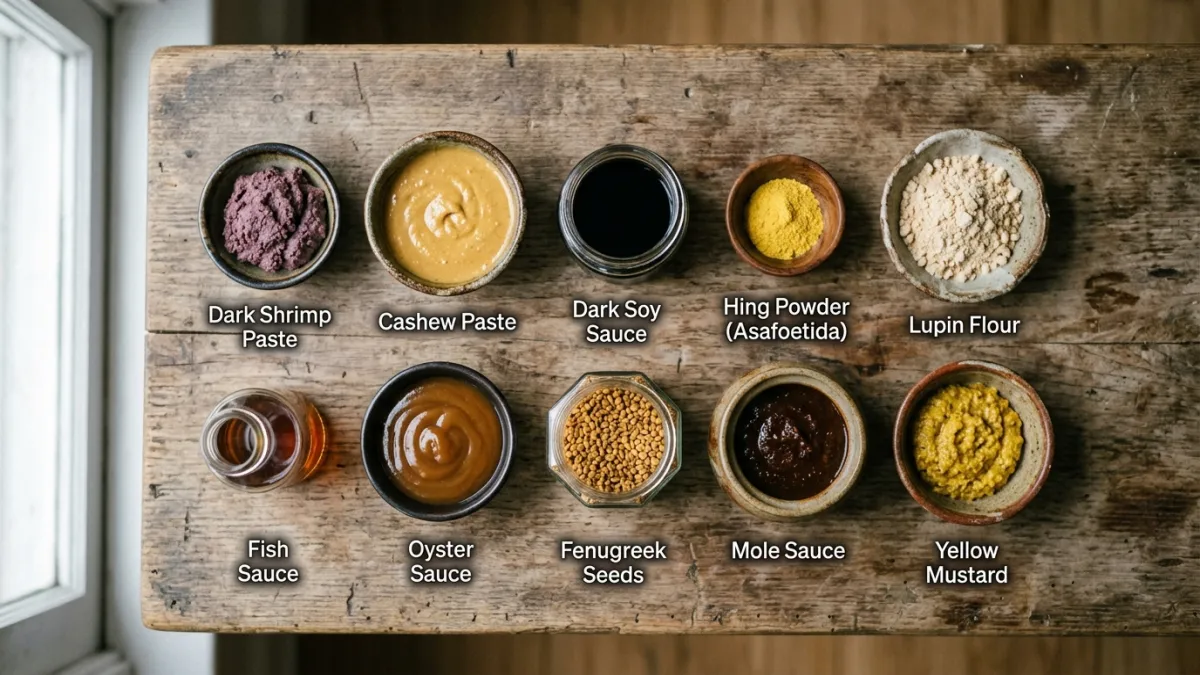
The most dangerous hidden allergens aren’t the ones you know about. They’re the fermented pastes dissolved into curry bases, the wheat flour bulking out a “spice,” and the tree nut paste thickening a “tomato” gravy. Invisible in the finished dish, unlabeled on menus, and often unknown even to the kitchen staff serving them.
TL;DR: The 10 most dangerous hidden allergens in global cuisines, ranked by how widespread and invisible they are. From shrimp paste dissolved into every Thai curry to lupin flour hiding in European gluten-free bread, these are the traps that catch even experienced travelers. Each entry includes what it is, where it hides, and how to protect yourself.
This article is for informational purposes. Always consult your allergist and verify directly with kitchen staff. No guide can guarantee safety.
Why Are Hidden Allergens More Dangerous When Traveling?
What Makes an Allergen “Hidden”?
A hidden allergen doesn’t show up on a menu, isn’t visible in the finished dish, and often isn’t recognized as an allergen by the people cooking it. At home, you control your ingredients. Abroad, you’re trusting a kitchen that may not share your language or your country’s allergen disclosure laws.
According to PMC (Accidental Reactions to Foods, 2022), in 50% of restaurant allergic reactions, the allergen was hidden in sauces or dressings. And per FARE (2021), 53.9% of reactions happened despite the diner informing staff.
“Travelers with food allergies should carry translated allergy cards and verify ingredients directly with kitchen staff, not front-of-house servers.” — FARE (Food Allergy Research & Education)
A 2023 study in the Annals of Allergy found that 68% of food-allergic patients limit their vacation destinations. Here are the 10 traps, ranked by how widespread and invisible they are.
#1. Why Is Shrimp Paste the Most Dangerous Hidden Allergen?
Where Does Shrimp Paste Hide?
Shrimp paste is the single most geographically widespread hidden allergen in global cuisine. It goes by at least seven names across Southeast and East Asia: kapi (กะปิ) in Thailand, belacan in Malaysia, terasi in Indonesia, bagoong in the Philippines, saeu-jeot (새우젓) in Korea, mam tom (mắm tôm) in Vietnam, and xiājiàng (虾酱) in China.
The reason it’s number one: it’s in every traditional Thai curry paste, including “vegetable” curries. It’s in most traditional kimchi. It’s in laksa, tom yum, rojak, nasi lemak, and nam phrik phao (Thai chili jam). Once fermented and cooked into a sauce base, it’s completely invisible. You can’t see it, and you likely can’t taste it as a distinct ingredient.
According to FARE (2019), 19% of food allergy reactions occur in Asian restaurants, the highest category by cuisine type. For the full breakdown of every shrimp paste variant by country, including avoidance phrases in local languages, see the Global Shrimp Paste Map.
#2. Why Does Cashew Paste Hide in “Tomato” Gravies?
Which Indian Dishes Contain Hidden Cashew?
You’re scanning the menu at an Indian restaurant and butter chicken sounds straightforward. Tomato-based, creamy, no nuts mentioned. But that creamy texture? It usually comes from cashew paste ground into the gravy base.
Korma, butter chicken, makhani, navratan korma, and anything labeled “shahi” or “malai” almost certainly contains ground cashew or almond paste as a thickener. The words “shahi” (royal) and “malai” (cream) are your warning signals. Many restaurants buy pre-made curry base from suppliers, and the kitchen staff may genuinely not know it contains cashews. Cross-contact is near-certain in most Indian restaurant kitchens where multiple gravies share the same prep surfaces and utensils.
According to FARE (2024), 33 million Americans have food allergies (roughly 6%), and tree nuts are consistently among the top anaphylaxis triggers. If you have a tree nut allergy, tandoori dishes and South Indian rice-based dishes are generally your lower-risk options.
#3. Does Soy Sauce Contain Enough Wheat to Trigger Celiac?
Does Soy Sauce Really Contain Wheat?
Standard soy sauce is brewed from roughly equal parts soybeans and wheat. Koikuchi shoyu, the most common Japanese soy sauce, is about 50% wheat by ingredient. That means every teriyaki glaze, every stir-fry sauce, every marinade in a Japanese, Chinese, or Korean kitchen likely contains wheat.
It goes deeper than just soy sauce. Shaoxing wine, used in most Chinese stir-fries and braises, is also wheat-fermented. Japanese curry roux uses wheat flour. Even tamari, often marketed as a soy sauce alternative, may contain wheat unless it’s specifically labeled gluten-free. For the full breakdown, see Does Soy Sauce Have Wheat? and Can You Eat Gluten-Free in Japan?.
With 3.4 million food-allergy-related ER visits annually in the US (FARE, 2024), soy sauce’s ubiquity across East Asian cuisine makes it one of the hardest allergens to avoid when traveling.
#4. Why Does Asafoetida (Hing) Contain Wheat?
How Much Wheat Is Actually in Hing Powder?
Over 90% of commercial hing powder sold in India is compounded with wheat flour, typically 50-70% wheat by weight, according to NIFTEM (National Institute of Food Technology, Entrepreneurship and Management, India). The pure asafoetida resin is naturally gluten-free, but manufacturers cut it with wheat flour as cheap filler and anti-caking agent.
Hing goes into the tadka (hot oil tempering) that’s the foundation of virtually every dal and many vegetable preparations. Cooks often prepare tadka in bulk, meaning one batch of wheat-containing hing contaminates everything it touches. Kitchen staff don’t think of hing as a wheat product. It’s filed under “spice” in their mental model, so asking “does this contain wheat?” often gets a truthful but wrong “no.”
Rice-flour-based alternatives exist but are specialty items, rare in mainstream Indian markets. For the complete guide to this trap, including safe South Indian alternatives and Hindi/Tamil allergy phrases, see The Asafoetida Gluten Trap in Indian Food.
#5. Can Lupin Flour in European Bread Trigger Peanut Allergy?
Can Lupin Trigger a Peanut Allergy Reaction?
Yes. Lupin is a legume in the same botanical family as peanuts, and clinical cross-reactivity rates range from 5-37% depending on the study, with approximately 30% in controlled trials (ASCIA / Annals of Allergy). The reaction threshold can be as low as 50mg of lupin protein.
France permitted lupin flour in wheat flour blends in 1997, and it spread across European baking from there. Today, lupin flour shows up in gluten-free breads, pasta, pastries, and baked goods across the EU. If you’re avoiding wheat because of a peanut-legume cross-sensitivity, the gluten-free alternative may contain the one flour most likely to trigger your peanut allergy.
Lupin was the 4th most frequent cause of severe food anaphylaxis in France as of 2002, and the FDA now advises peanut-allergic consumers to avoid lupin. The EU requires lupin labeling, but the US, Australia, and many Asian countries do not. If you’re peanut-allergic and traveling in Europe, read every bakery label, even on items marketed as gluten-free.
#6. Why Is Fish Sauce Invisible in So Many Asian Dishes?
Is There Fish in Miso Soup?
Almost certainly. Miso soup’s base is dashi, a stock made from bonito flakes (dried, fermented tuna). Dashi isn’t just in miso soup. It’s the invisible backbone of Japanese cuisine: in tamagoyaki (egg rolls), nimono (simmered vegetables), chawanmushi (egg custard), and even some pickles and rice seasonings. Many dishes that appear to be purely vegetable-based contain dashi.
In Thailand and Vietnam, fish sauce plays a similar role. Nam pla (Thai), nuoc mam (Vietnamese), patis (Filipino), and aekjeot (Korean) function like salt in their respective cuisines. They’re in virtually every savory dish, and they’re never listed as a separate ingredient on restaurant menus because they’re considered as fundamental as salt or oil.
According to FARE (2021), 34% of food-allergic individuals report at least one allergic reaction in a restaurant. Fish sauce and dashi are major contributors because they’re treated as background seasoning, not as an ingredient worth mentioning.
#7. Does Oyster Sauce Contain Both Shellfish and Gluten?
Does Oyster Sauce Contain Gluten?
Oyster sauce is a double allergen trap. It contains real oyster extracts (a mollusk allergen) and most major brands use wheat flour as a thickener. That’s shellfish and gluten in one condiment, and it’s the default finishing sauce for stir-fried vegetables across Chinese, Thai, and Korean restaurant kitchens.
| Allergen | Present in Oyster Sauce? | Risk Level |
|---|---|---|
| Mollusk (oyster extract) | Yes, always | High for shellfish allergy |
| Wheat (flour thickener) | Most brands | High for celiac/wheat allergy |
| Soy | Often present | Moderate for soy allergy |
You’re ordering stir-fried morning glory or Chinese broccoli thinking it’s a safe vegetable dish. The oyster sauce went in during the last 30 seconds of cooking and nobody thought to mention it. Even dishes listed as “vegetable stir-fry” routinely contain oyster sauce unless you specifically request otherwise. Ask for dishes cooked with just oil and garlic, and confirm they’ll skip the oyster sauce.
#8. Can Fenugreek in Curry Trigger a Peanut Allergy?
How Does Fenugreek Cross-React With Peanut?
Fenugreek’s IgE-binding proteins show structural homology to peanut allergens Ara h 1 and Ara h 3. In a study of 195 peanut-allergic children, 66% showed sensitization to fenugreek, and 10% had documented clinical cross-reactivity (PMC, Fenugreek Allergy Cross-Reactivity, 2024). Norway’s Food Allergy Register has attributed cases of anaphylaxis in peanut-allergic individuals directly to fenugreek in Indian food.
The problem is invisibility. Fenugreek (methi in Hindi) is in most Indian curry powders, many dal preparations, and numerous spice blends across the Middle East and North Africa. On packaged food labels, it’s often hidden under the catch-all term “spices.” In a restaurant, asking “does this contain fenugreek?” will usually get a blank look. The cook adds a pre-mixed spice blend and may not know every ingredient in it.
If you have a peanut allergy and you’re eating Indian food, fenugreek is a risk you should discuss with your allergist before traveling.
#9. Why Is Mole the Most Allergen-Dense Sauce in the World?
What Allergens Are in Mole Sauce?
Mole negro from Oaxaca may be the most allergen-dense single sauce in world cuisine. A traditional recipe can contain peanuts, sesame seeds, almonds, walnuts, pecans, chocolate, bread (wheat), and lard (for those avoiding animal products). That’s 8 or more allergens in one preparation, and on the menu it’s listed simply as “mole.”
| Allergen | Common in Mole? | Notes |
|---|---|---|
| Peanuts | Yes | Ground into paste |
| Sesame | Yes | Toasted and ground |
| Tree nuts (almond, walnut, pecan) | Often | Varies by recipe |
| Wheat (bread) | Usually | Bread used as thickener |
| Chocolate | Almost always | Contains dairy and soy |
| Lard | Traditional | Animal fat |
There’s a bonus trap in Oaxacan cuisine: chapulines (grasshoppers). The tropomyosin protein in insects cross-reacts with crustacean shellfish allergens. If you’re allergic to shrimp or crab, chapulines can trigger a reaction too.
When you’re facing a sauce with 20+ ingredients in a language you might not speak fluently, tools like Menu Decoder can help you flag potential allergens before you start the conversation with kitchen staff. But always confirm directly. No tool replaces talking to the cook.
#10. Why Is Mustard a Hidden Danger for Non-European Travelers?
Why Is Mustard Dangerous for Travelers From Outside Europe?
Mustard is a declared allergen in the EU, which means European food labels must list it. But it’s not a declared allergen in the US, Australia, or most Asian countries. If you’re an American or Australian traveler with a mustard allergy, your home country’s labeling system hasn’t trained you to look for it.
In French cuisine, mustard is everywhere. An estimated 66% of French cold sauces contain mustard. It’s in vinaigrettes, bearnaise, gribiche, compound butters, and many charcuterie preparations. Anything labeled “Dijon” obviously contains it, but it also shows up in emulsified sauces where you wouldn’t expect it, acting as both a flavoring and an emulsifier.
The regulatory gap is the real danger. In Paris, a restaurant will likely flag mustard on the menu because EU law requires it. In Bangkok or New York, the same ingredient might appear in a French-inspired dish with no disclosure at all because local law doesn’t require it.
Frequently Asked Questions
What Is the Most Common Hidden Allergen in Asian Food?
It depends on the allergy. For shellfish allergies, shrimp paste is the biggest threat. It’s in virtually every Thai curry paste, most traditional kimchi, and condiments across at least eight countries. For gluten and celiac, soy sauce is the trap. Standard soy sauce is about 50% wheat and it’s in every teriyaki, stir-fry sauce, and marinade across Japanese, Chinese, and Korean kitchens. Fish sauce (nam pla, nuoc mam) is the third major hidden allergen, functioning like salt in Thai and Vietnamese cooking. According to FARE, 19% of all food allergy reactions occur in Asian restaurants, more than any other cuisine category. The combination of fermented condiments, language barriers, and limited allergen disclosure laws makes Southeast and East Asia particularly challenging for allergic travelers.
Can You Be Allergic to Lupin if You’re Allergic to Peanuts?
Yes. Cross-reactivity rates run 5-37% across studies, roughly 30% in controlled trials (ASCIA / Annals of Allergy). The FDA advises peanut-allergic consumers to avoid lupin. Lupin flour is common in European gluten-free breads, pasta, and pastries, particularly in France, Italy, and Germany where it was adopted as a wheat alternative. The EU requires lupin labeling, but the US, Australia, and many Asian countries do not. Reaction thresholds can be as low as 50mg of lupin protein, which is easily reached in a single slice of bread. If you have a peanut allergy and you’re traveling in Europe, treat any unlabeled bakery product as a potential risk. Ask specifically about lupin, especially in items marketed as gluten-free or high-protein.
Is Oyster Sauce Safe for Shellfish Allergy?
No. It contains real oyster extracts (mollusk allergen) plus wheat flour as thickener. That’s shellfish and gluten in one condiment. It’s the default finishing sauce for stir-fried vegetables across Chinese, Thai, and Korean kitchens. “Vegetable stir-fry” on a menu likely contains it unless you explicitly ask otherwise. Most major brands, including Lee Kum Kee and Maekrua, use wheat flour in their formulations. Vegetarian oyster sauce (mushroom-based) exists and is usually safe for both shellfish and gluten, but you need to specifically request it and confirm the restaurant carries it. In Cantonese cooking, oyster sauce also goes into braised dishes, clay pot rice, and lo mein. The safest approach is to ask for dishes cooked with only oil and garlic, and confirm no oyster sauce will be added at any stage.
Which Country Is Hardest to Travel With Food Allergies?
Thailand, Japan, and Korea are among the hardest. Thailand combines shrimp paste (kapi) in all curries with fish sauce (nam pla) as default seasoning, making it extremely difficult for both shellfish and fish allergies. Japan layers dashi (fish stock) into most savory dishes alongside wheat-based soy sauce in virtually everything, creating overlapping traps for fish, wheat, and soy allergies. Korea uses saeu-jeot (shrimp paste) in most kimchi and soy-based sauces everywhere else. Malaysia and Indonesia are close to impossible for shellfish allergies because belacan and terasi are foundational to the cuisine. The answer also depends on your specific allergy. India is one of the hardest for tree nut allergies (cashew paste in gravies), while France is uniquely challenging for mustard allergies. Direct communication with kitchen staff, allergy cards in the local language, and pre-screening menus are your best defenses in any destination.
Can Grasshoppers Trigger a Shellfish Allergy?
Yes. Tropomyosin, the protein responsible for most crustacean shellfish allergies, is also present in insects. Documented anaphylaxis cases have been linked to chapulines (grasshoppers) in Oaxacan cuisine among individuals with shrimp or crab allergies (Annals of Allergy, 2020). This cross-reactivity extends to crickets, mealworms, and silkworm larvae, all of which share the same protein family. As insect-based foods become more common globally, from cricket protein bars in the US to silkworm snacks in Korea and Thailand, this is a growing risk. In Oaxaca specifically, chapulines are served as bar snacks, taco fillings, and salad toppings, often without any allergy warning. If you’re shellfish-allergic and traveling in Mexico or any country where insects are part of the cuisine, treat them as a shellfish-equivalent product and ask before eating.