
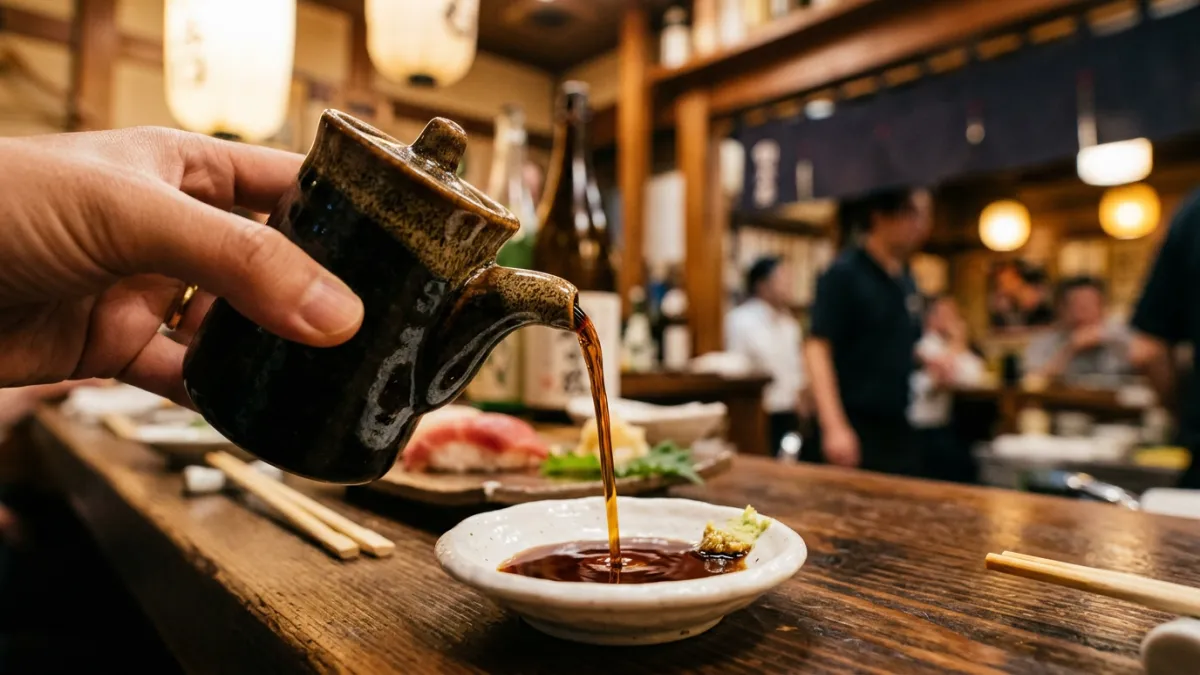
Yes, but it takes real preparation. Standard Japanese soy sauce is brewed from approximately 50% wheat, and soy sauce shows up in virtually every sauce, marinade, glaze, and dipping dish across Japan. The problem isn’t finding rice. It’s that almost everything touching the rice contains hidden wheat.
TL;DR: Soy sauce is roughly half wheat, and it’s the base ingredient in teriyaki, ponzu, tonkatsu sauce, yakisoba sauce, and most marinades in Japan. Tamari (wheat-free versions) is the safe swap. Convenience stores are your best fallback because packaged food labeling is mandatory. Restaurants have zero legal obligation to disclose allergens.
This article is for informational purposes. If you have celiac disease or a wheat allergy, consult your doctor before making dietary changes. Restaurant situations vary, and no guide can guarantee safety.
Why Is Gluten So Hard to Avoid in Japan?
Three things collide to make Japan uniquely difficult for celiac travelers.
First, soy sauce is everywhere. Koikuchi, the standard dark soy sauce, accounts for 80% of all soy sauce consumed in Japan, and it’s brewed from approximately 50% wheat (Kikkoman production data). Wheat is a core brewing ingredient, not trace contamination. And soy sauce doesn’t just sit on the table. It’s cooked into sauces, brushed onto grilled meats, simmered into broths, and mixed into marinades you’ll never see.
Why Is Celiac Awareness So Low in Japan?
Diagnosed celiac prevalence in Japan sits around 0.05%, compared to roughly 1.4% by serological screening (Singh et al., 2018, Clinical Gastroenterology and Hepatology; Fukunaga et al., 2018, Journal of Gastroenterology). The genetic predisposition (HLA-DQ2) appears in just 0.3% of the Japanese population, versus 20-30% in Western populations (PMC7411549). Most restaurant staff have simply never encountered a celiac customer.
On top of that, restaurants have no legal requirement to disclose allergens. Japan mandates labeling for 9 allergens on packaged food, but restaurants are exempt (Consumer Affairs Agency of Japan). With 42.7 million international visitors in 2025 (JNTO), more gluten-free travelers are hitting this gap every year. For how Japan compares to other destinations, see the celiac country-by-country ranking.
Which Japanese Sauces and Seasonings Contain Hidden Wheat?
The real danger isn’t the soy sauce bottle sitting on the table. You can see that one coming. It’s the cascade of sauces built on a soy sauce base that are already cooked into your food before it reaches you. We compiled this from Japanese-language ingredient data. Most English-language guides list soy sauce as the problem but don’t map the 11+ downstream sauces it feeds into.
| Sauce / Seasoning | Contains Wheat? | Where You’ll Encounter It |
|---|---|---|
| Koikuchi (standard dark soy sauce) | Yes, ~50% wheat | Table condiment, marinades, broths, glazes |
| Usukuchi (light soy sauce) | Yes, contains wheat | Kansai-region cooking, lighter-colored dishes |
| Shiro (white soy sauce) | Yes, MORE wheat than standard | Aichi specialty, chawanmushi, light broths |
| Saishikomi (re-brewed soy sauce) | Yes, contains wheat | Dipping sauces, sashimi |
| Teriyaki glaze | Yes (soy sauce + mirin) | Grilled meats, bento boxes |
| Yakisoba sauce | Yes (soy sauce base) | Stir-fried noodles, festival food |
| Tonkatsu sauce | Yes (soy sauce + fruit + vinegar) | Fried cutlets, korokke |
| Ponzu | Yes (soy sauce + citrus) | Hot pot, salads, sashimi |
| Yakiniku tare (BBQ sauce) | Yes (soy sauce base, often sesame) | Grilled meats, yakiniku restaurants |
| Mentsuyu (noodle dipping sauce) | Yes (dashi + soy sauce) | Soba, udon, tempura dipping |
| Tsukudani | Yes (soy sauce simmered preserves) | Rice toppings, side dishes |
| Tamari (wheat-free) | Usually no, but check label | Chubu region specialty |
According to the Annals of Allergy, Asthma & Immunology, 30% of food-allergic travelers experienced allergic reactions during trips abroad, with restaurants as the primary cause. In Japan, the sauce cascade is a major reason why.
For a deeper look at how soy sauce and wheat interact across all Asian cuisines, see the full soy sauce and wheat guide.
Does Miso Contain Gluten?
It depends entirely on the type. Miso is fermented paste made from soybeans and a koji (fermentation culture) starter, but the base grain varies, and that’s what determines whether it’s safe.
| Miso Type | Base Ingredient | Contains Gluten? |
|---|---|---|
| Mugi-miso (barley miso) | Barley koji | Yes (barley = gluten) |
| Awase-miso (blended) | Mixed, may include barley | Maybe. Must check |
| Kome-miso (rice miso) | Rice koji + soybeans | No (usually safe) |
| Mame-miso / Hatcho-miso | Soybeans only | No (safest option) |
Mame-miso and Hatcho-miso are the safest choices for celiac travelers. They’re soy-only, with no wheat or barley in the fermentation. Hatcho-miso is a specialty of the Aichi region (central Japan), so you’re more likely to find it there. When ordering miso soup elsewhere, you usually can’t verify which miso type the kitchen uses, which makes miso soup a gamble outside of restaurants that specifically cater to allergies.
Does Japanese Curry Contain Gluten?
Almost always, yes. Japanese curry gets its signature thick, sweet texture from commercial roux blocks, and those blocks use wheat flour as the primary thickener. Major brands like House Vermont Curry and S&B Golden Curry both contain wheat flour and milk powder. House does make an “Allergen Free” version that substitutes rice flour, but most restaurants and home cooks use the standard blocks.
The other trap: Japanese curry is commonly served with tonkatsu (breaded deep-fried pork cutlet), which adds a second wheat source via the panko coating. Indian curry restaurants in Japan are actually a safer bet for celiac travelers because they typically use spice pastes instead of roux. If a menu says “curry rice” (カレーライス), assume wheat is in it unless the restaurant specifically advertises gluten-free options.
Which Japanese Dishes Are Usually Safe for Gluten-Free Diets?
Japan isn’t all danger. Several traditional dishes are naturally wheat-free, as long as you handle the soy sauce question. According to FARE, food allergies affect approximately 10% of US adults, many of whom visit Japan without knowing these options exist.
| Dish | Usually Safe? | What to Watch For |
|---|---|---|
| Sashimi (raw fish, no rice) | Yes | Skip the soy sauce. Ask for salt or bring tamari |
| Plain white rice (gohan) | Yes | Rarely an issue |
| Onigiri (rice balls) | Usually | Check fillings. Some use soy-based seasonings |
| Edamame (with salt only) | Yes | Skip if served with soy sauce glaze |
| Yakitori with shio (salt) | Yes | Must specify “shio.” Default tare sauce contains soy |
| Shioyaki (salt-grilled fish) | Yes | Confirm no soy sauce marinade was used |
| Grilled vegetables (shio) | Yes | Specify salt only, not tare |
| Towari soba (100% buckwheat) | Usually | Must confirm 100% buckwheat. Most “soba” is mixed with wheat flour |
A critical note on soba noodles: buckwheat itself is gluten-free, but the vast majority of soba in Japan is made with a blend of buckwheat and wheat flour. Only “towari soba” or “juwari soba” (十割そば) is 100% buckwheat. Even then, the dipping sauce (mentsuyu) contains soy sauce. Bring your own tamari.
How Do You Tell a Restaurant About Your Wheat Allergy in Japanese?
The single most important phrase is: 小麦アレルギーです (komugi arerugii desu), meaning “I have a wheat allergy.” Say it directly to the person cooking your food, not just the server.
| Situation | Japanese | Romaji |
|---|---|---|
| I have a wheat allergy | 小麦アレルギーです | komugi arerugii desu |
| Does this contain soy sauce? | 醤油は入っていますか? | shōyu wa haitte imasu ka? |
| Does this contain wheat? | 小麦は入っていますか? | komugi wa haitte imasu ka? |
| I cannot eat wheat | 小麦が食べられません | komugi ga taberaremasen |
Do Allergy Cards Actually Work in Japan?
Yes, and they’re arguably more effective here than in most countries. Japanese staff tend to take written communication seriously. Carry a printed allergy card in Japanese that explains your condition, including that soy sauce is unsafe. The Tokyo Metropolitan Government publishes free downloadable allergy communication sheets with pictograms in multiple languages.
“Travelers with food allergies should carry translated allergy cards and verify ingredients directly with kitchen staff, not front-of-house servers.” - FARE (Food Allergy Research & Education)
Show the card to kitchen staff specifically. The waiter relaying your message through a busy kitchen is where mistakes happen. Tools like SafelyFed’s Menu Decoder can also help before you sit down. You photograph a Japanese menu and it flags dishes containing wheat or soy sauce based on your allergy profile. But no digital tool replaces the allergy card and direct conversation with the chef.
Which Restaurants Are Safest for Gluten-Free Eating?
Not all dining situations carry the same risk. Here’s a practical safety ranking based on how much control you have over ingredients.
| Restaurant Type | Safety Level | Why |
|---|---|---|
| Dedicated GF restaurants (Gluten Free T’s Roppongi, AIN SOPH, Littlebird Cafe) | Best | Entire menu designed around allergen avoidance |
| International hotel restaurants | Good | Staff trained for international dietary needs, English-speaking |
| Chain restaurants with allergen charts (Coco Ichibanya, Kura Sushi) | Good | Published allergen info, standardized recipes |
| Shojin ryori (temple cuisine) | Moderate | Plant-based, but soy sauce and wheat-based fu are common |
| Izakaya (Japanese pubs) | Poor | Shared fryers, soy sauce in most dishes, fast-paced kitchens |
| Street food / matsuri (festival) stalls | Worst | No allergen info, shared equipment, impossible to verify |
Are Convenience Stores a Reliable Fallback?
Your best everyday option in Japan is the konbini. 7-Eleven, Lawson, and FamilyMart are everywhere, with over 56,000 locations nationwide. Here’s the key advantage: all packaged food in Japan must list the 9 mandatory allergens, including wheat (Consumer Affairs Agency of Japan). Japan also prohibits “may contain” (precautionary allergen labeling), which means if wheat IS listed, it’s definitely present above 10 ppm. Absence from the label doesn’t guarantee absence, but the system is more precise than most countries.
Learn to spot 小麦 (komugi, wheat) on labels. Onigiri, plain rice, certain snacks, and some bento options are identifiable as wheat-free directly from the packaging. Food allergy prevalence in Japan itself has been rising, doubling from 0.47% to 1.03% between 2010 and 2019 (Yoshisue et al., 2024, Pediatric Allergy and Immunology). This is slowly increasing domestic awareness, but for now, konbini remain your most reliable daily fallback.
For a broader guide covering all food allergies in Japan (not just gluten), see the complete Japan food allergy guide.
What Are the Most Common Regional Gluten Traps?
Japan’s food culture varies dramatically by region. Some local specialties are gluten traps that catch even prepared travelers. According to JNTO, regional food tourism is one of the top three reasons international visitors explore beyond Tokyo, making these traps relevant to most itineraries.
Okinawa: Soki soba uses wheat noodles despite the word “soba” in the name. It has nothing to do with buckwheat. The broth also typically contains soy sauce.
Osaka: The city is famous for okonomiyaki (savory pancakes), takoyaki (octopus balls), and kushikatsu (deep-fried skewers). All three are wheat-batter-based. Osaka street food is essentially a gluten-free exclusion zone.
Nagoya: Miso-nikomi udon features wheat udon noodles in a miso broth. Tebasaki (chicken wings) are coated in wheat flour. The local miso is often Hatcho-miso (soy-only, safe), but the dishes built around it frequently include wheat.
Hokkaido: Butter ramen uses wheat noodles. Soup curry sometimes includes wheat-thickened broth, though lighter versions may be safer.
What Else Do Celiac Travelers Ask About Japan?
Is soy sauce gluten-free in Japan?
No. Standard soy sauce (koikuchi) is brewed from approximately 50% wheat and accounts for about 80% of all soy sauce in Japan (Kikkoman production data). Wheat is a core brewing ingredient, not a trace additive. Roasted wheat provides sugars that fermentation cultures need to produce soy sauce’s characteristic flavor. The resulting gluten content is well above the 20 ppm threshold used for “gluten-free” labeling in most countries. Tamari, traditionally brewed with little or no wheat, is the primary alternative. However, not all tamari is wheat-free. Some Japanese brands include small amounts of wheat. Always look for explicit “gluten-free” labeling on the bottle. Coconut aminos work as a substitute if you’re avoiding both soy and wheat.
Can celiacs eat sushi in Japan?
With modifications, usually yes. Plain sushi rice (seasoned with rice vinegar, sugar, and salt) is typically gluten-free, and the fish itself is safe. The problems start with everything surrounding the fish. The soy sauce served alongside sushi is wheat-based. Imitation crab (kanikama) is bound with wheat starch. Tempura rolls involve wheat batter. Some restaurants even add trace soy sauce to their vinegared rice. Your safest approach: order sashimi or nigiri with real fish, bring your own wheat-free tamari, and confirm with the chef that no soy-based seasoning was added to the rice. Conveyor-belt chains like Kura Sushi publish allergen charts for every item, making them more practical than traditional sushi bars for celiac diners.
Is miso soup gluten-free?
It depends on which type of miso the restaurant uses. Mugi-miso (barley miso) contains barley, which is a gluten grain. Kome-miso (rice miso) and mame-miso (soybean-only miso) are typically gluten-free. Hatcho-miso, a specialty of Aichi prefecture, is made entirely from soybeans and is the safest option. The challenge is that most restaurants don’t specify which miso they use, and blended miso (awase-miso) may contain barley. The dashi broth itself is usually safe (kombu seaweed and bonito flakes), but some versions include soy sauce. If you can confirm the restaurant uses kome-miso or mame-miso and a soy-sauce-free dashi, miso soup is likely safe. In practice, that confirmation is hard to get at a typical Japanese restaurant, making miso soup a moderate-risk choice for celiac travelers.
Does Japanese curry contain gluten?
In almost every case, yes. Unlike Indian or Thai curries that use spice pastes, Japanese curry relies on commercial roux blocks where wheat flour is the primary thickener. This is why Japanese curry has that distinctively thick, gravy-like consistency. Both House Vermont Curry and S&B Golden Curry blocks contain wheat flour and milk powder. House Foods does produce an “Allergen Free” version using rice flour, but it’s rarely stocked in restaurants. The other trap: Japanese curry is commonly served with tonkatsu (breaded deep-fried pork cutlet), adding a second wheat source via the panko coating. Indian curry restaurants in Japan are a safer option since they typically use spice pastes, not roux. If you see “curry rice” (カレーライス) or “katsu curry” on a menu, assume wheat.
Is tamari really gluten-free?
Usually, but not automatically. Tamari is traditionally brewed with little or no wheat, making it the most common gluten-free soy sauce recommendation. In the Chubu region (around Nagoya), tamari is the default local soy sauce. The catch: “tamari” is not a regulated gluten-free term. Some Japanese brands add small amounts of wheat. Outside Japan, brands like San-J and Kikkoman produce tamari specifically labeled “gluten-free,” tested below 20 ppm. Inside Japan, read the ingredient label for 小麦 (komugi, wheat). If you’re packing for a trip, bringing verified gluten-free tamari from home is more reliable than hunting for it in Japanese supermarkets. Flavor-wise, tamari is darker, thicker, and slightly richer than standard soy sauce, but works as a direct substitute in nearly every context.
Where should you eat gluten-free in Tokyo specifically?
Tokyo has the best gluten-free dining scene in Japan, though it’s still small. Gluten Free T’s in Roppongi offers an entirely gluten-free menu with Japanese and Western dishes. AIN SOPH has multiple locations and focuses on plant-based, allergen-aware dining. Littlebird Cafe in Meguro serves gluten-free baked goods. For chains, Coco Ichibanya publishes full allergen charts, and Kura Sushi provides allergen information for every plate. Hotel restaurants in Shinjuku, Marunouchi, and Roppongi generally have English-speaking staff trained for dietary restrictions. Your most reliable daily option remains the konbini. Tokyo’s density of convenience stores means you’re never far from packaged food with mandatory allergen labeling. For the full country guide covering all allergens beyond gluten, see the Japan food allergy travel guide.