
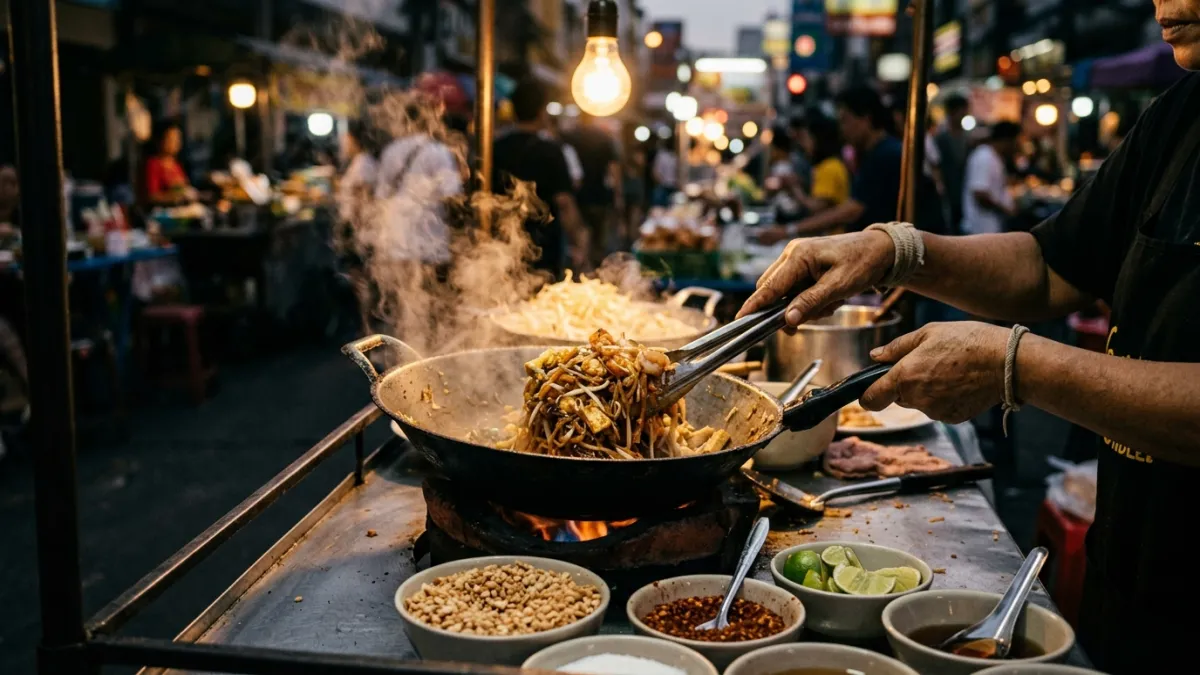
Yes. Most Thai dishes are peanut-free. The curries, stir-fries, soups, and grilled meats that make up the majority of Thai cooking rarely include peanuts. The real risks cluster around a short list of specific dishes: pad thai, satay, som tam, and massaman curry. If you know which dishes to skip and how to communicate your allergy in Thai, eating well in Thailand is very doable.
TL;DR: Thai food is more peanut-friendly than most people expect. Green curry, red curry, tom yum, pad kra pao, and grilled meats are all traditionally peanut-free. The danger dishes are pad thai, satay, som tam Thai, massaman curry, panang curry, and miang kham. Learn “mai sai thua lisong” (ไม่ใส่ถั่วลิสง) and carry an allergy card in Thai script.
This article is for informational purposes. If you have a peanut allergy, consult your allergist before making dietary decisions based on this content. Restaurant situations vary, and no guide can guarantee safety.
Which Thai Dishes Contain Peanuts?
The dishes that contain peanuts fall into two categories: those where peanuts are a core ingredient (skip entirely) and those where peanuts appear as a garnish (possible to modify, but cross-contamination risk remains). According to data from the US Peanut and Tree Nut Registry (Sicherer et al., JACI, 2001), 50% of peanut and tree nut reactions at restaurants involved “hidden” allergens in sauces, pastes, and preparations.
“Travelers with food allergies should carry translated allergy cards and verify ingredients directly with kitchen staff, not front-of-house servers.” — FARE (Food Allergy Research & Education)
In Thai food, peanuts are at least visible most of the time. That’s a genuine advantage compared to allergens like shrimp paste or fish sauce, which dissolve into dishes invisibly. Here is the full breakdown:
| Dish | Thai Name | Peanut Role | Can It Be Made Without? |
|---|---|---|---|
| Pad thai | ผัดไทย | Crushed peanuts as garnish | Possible, but shared wok risk. Condiment jars on tables often contain crushed peanuts |
| Som tam Thai | ส้มตำไทย | Pounded into the salad | Unlikely. Peanuts mixed during prep. Mortar cross-contamination probable |
| Satay | สะเต๊ะ | Peanut dipping sauce is the defining element | No. Skip entirely |
| Massaman curry | แกงมัสมั่น | Roasted peanuts cooked into the curry | No. Peanuts are a core ingredient |
| Miang kham | เมี่ยงคำ | Chopped peanuts as a core filling | No. Required in traditional recipe |
| Gaeng hang lay | แกงฮังเล | Peanuts in the curry paste | No. Traditional northern recipe |
| Coconut ice cream | ไอศกรีมกะทิ | Crushed peanuts as default topping | Yes, if you stop the vendor before toppings go on |
| Spring roll dipping sauce | น้ำจิ้มปอเปี๊ยะ | Ground peanut in hoisin-based sauce | Ask for sweet chili sauce instead |
| Panang curry | พะแนง | Ground roasted peanuts in the curry paste | No. Peanuts are pounded into the paste itself |
| Khao soi (some versions) | ข้าวซอย | Peanut garnish on top | Yes, request no garnish |
Which Thai Dishes Are Usually Safe for Peanut Allergies?
The majority of Thai dishes contain no peanuts in any traditional recipe. Most curries, soups, stir-fries, and grilled meats are naturally peanut-free. Thailand welcomed 35 million international visitors in 2024 (Tourism Authority of Thailand), and the vast majority of food options across the country are peanut-free by default.
| Dish | Thai Name | Why Usually Safe | Watch Out For |
|---|---|---|---|
| Tom yum | ต้มยำ | No peanuts in any version | Shrimp paste, fish sauce |
| Tom kha gai | ต้มข่าไก่ | Coconut soup, no peanuts | Coconut, fish sauce |
| Green curry | แกงเขียวหวาน | Coconut curry, peanuts never in recipe | Shrimp paste, fish sauce, coconut |
| Red curry | แกงแดง | Same as green curry | Same |
| Pad kra pao | ผัดกระเพรา | Holy basil stir-fry, no peanuts | Oyster sauce, soy sauce, fish sauce, egg |
| Larb / laab | ลาบ | Meat salad, no peanuts | Fish sauce |
| Gai yang | ไก่ย่าง | Grilled chicken, no peanuts | Fish sauce in marinade |
| Moo ping | หมูปิ้ง | Grilled pork skewers, no peanuts | Fish sauce in marinade |
| Pineapple fried rice | ข้าวผัดสับปะรด | No peanuts | Egg, fish sauce, soy sauce |
| Pad see ew | ผัดซีอิ๊ว | No peanuts | Soy, wheat, egg, oyster sauce |
| Sticky rice + mango | ข้าวเหนียวมะม่วง | Dessert, no peanuts | Coconut only |
Note that while these dishes are peanut-free, many contain other allergens. Shrimp is the #1 confirmed food allergen in Thailand, accounting for 40% of positive oral food challenges in a 16-year hospital study (Asia Pacific Allergy, 2018). If you have allergies beyond peanuts, see the full Thailand allergy guide which covers shellfish, soy, gluten, and more.
Does Thai Food Use Peanut Oil?
No. This is one of the most common fears, and the answer is reassuring. Thai cooking uses vegetable oil for stir-frying and palm oil for deep frying. Peanut oil is not a standard cooking fat in Thailand, unlike in some Chinese or Vietnamese kitchens.
Peanut allergy affects an estimated 1.4-2% of the population in Western nations (Lieberman et al., Allergy, 2021). For that 2%, the peanut oil question matters enormously. In Thailand, it’s a non-issue in almost every kitchen you’ll encounter.
This means the risk is concentrated in the dishes themselves, not in the cooking medium. When peanuts show up in Thai food, they’re usually visible: crushed on top, pounded into a mortar, or stirred into a curry as whole roasted nuts. That visibility makes them easier to spot and avoid than allergens that disappear into sauces.
Does Peanut Risk Change by Region in Thailand?
Yes, and this is something most guides miss. The north of Thailand uses significantly more peanuts than the south or northeast. If you’re planning a trip to Chiang Mai, you need a different level of caution than in Bangkok or Isan.
Studies show that travelers with food allergies face meaningful risk of allergic reactions abroad, with significantly more anaphylactic reactions occurring on vacation compared to at home (Annals of Allergy, Asthma & Immunology, 2023). Regional awareness can meaningfully reduce that risk.
| Region | Peanut Risk | Key Detail |
|---|---|---|
| Central / Bangkok | Moderate | Pad thai, som tam, satay are main risks. Most curries peanut-free |
| Northern / Chiang Mai | Higher | More peanut use overall. Gaeng hang lay contains peanuts. Khao soi often served with peanut garnish |
| Isan / Northeastern | Lower | Heavy fermented fish, dried shrimp, sticky rice. Peanuts in som tam but less central to the cuisine |
| Southern / Phuket | Moderate-high | Massaman curry originates here. Cashews are a regional crop (tree nut, not peanut) |
The bottom line: Isan is likely the easiest region for peanut-allergic travelers. Northern Thailand requires the most vigilance.
How Do You Tell a Thai Restaurant About a Peanut Allergy?
Communication is the most important safety tool. Studies show that 19% of food allergy reactions in restaurants are attributed to Asian restaurants (US Peanut and Tree Nut Registry). Language barriers are a major factor. Having the right phrases in Thai script makes a real difference.
| English | Thai Script | Romanization |
|---|---|---|
| I am allergic to peanuts | ฉัน/ผมแพ้ถั่วลิสง | Chan/Phom pae thua lisong |
| Don’t add peanuts | ไม่ใส่ถั่วลิสง | Mai sai thua lisong |
| Does this have peanuts? | มีถั่วลิสงไหม | Mee thua lisong mai? |
| I will die if I eat peanuts | ถ้ากินถั่วลิสงจะตาย | Tha gin thua lisong ja tai |
| No peanut sauce | ไม่ใส่ซอสถั่วลิสง | Mai sai sauce thua lisong |
| No nuts at all | ไม่ใส่ถั่วทุกชนิด | Mai sai thua thuk chanit |
The phrase “tha gin thua lisong ja tai” (if I eat peanuts I will die) sounds dramatic, but it communicates severity in a way that “I’m allergic” sometimes doesn’t. Thai kitchen staff take this phrase seriously.
The most reliable approach combines two things: a physical allergy card in Thai script to show kitchen staff, and a way to verify the menu before you even start the conversation. I built Menu Decoder for the scanning part. You photograph the menu and it flags dishes based on your specific allergy profile. But the allergy card is equally important, because it communicates directly with the person cooking your food.
What About Thailand’s Allergen Labeling Laws?
Thailand’s 2024 allergen labeling law (Notification No. 450 from the Ministry of Public Health) made peanut allergen disclosure mandatory on prepackaged foods. This is a significant step forward for grocery shopping and convenience store snacks.
However, the law applies to packaged foods only. Street food, night markets, and sit-down restaurants are not covered. At the places where most travelers eat, you still need to rely on direct communication with kitchen staff and your own knowledge of which dishes to avoid.
Food allergy incidence in Thailand itself has increased 3-4x over four decades (Bangkok Post, 2024), so local awareness of allergies is genuinely improving. You are more likely to be understood today than even five years ago.
What Else Do People Ask About Peanuts and Thai Food?
Is Pad Thai Safe for Peanut Allergies?
Not without modification and some risk. Pad thai traditionally has crushed peanuts on top as a garnish. You can ask for it without peanuts (“mai sai thua lisong”), and many cooks will accommodate the request. The issue is cross-contamination. Pad thai is cooked in a shared wok that likely had peanuts in the previous batch. Condiment trays at the table usually include a jar of crushed peanuts right next to the chili flakes and sugar. For mild peanut sensitivity, ordering without peanuts may be adequate. For severe anaphylactic allergy, the shared wok and condiment jar risk means pad thai is better skipped entirely. Data shows that 7-14% of peanut-allergic patients experience accidental exposure annually, with one-third to one-half of those experiencing anaphylaxis (Lieberman et al., Allergy, 2021).
Does Thai Food Use Peanut Oil?
No. Thai cooking relies on vegetable oil for stir-frying and palm oil for deep frying. Peanut oil is not a traditional Thai cooking fat. This is genuinely good news for peanut-allergic travelers, because it means the base cooking method is usually safe. The risks come from specific dishes where peanuts are an intentional ingredient or garnish, not from the oil in the wok. This is a meaningful difference from some Chinese regional cuisines where peanut oil is standard. Among people with peanut allergy, fatal anaphylaxis occurs at a rate of 2.13 per million peanut-allergic person-years (Umasunthar et al., Clinical & Experimental Allergy, 2013). Knowing that the oil is safe narrows the risk to a manageable list of dishes you can memorize.
Is Massaman Curry Safe for Peanut Allergies?
No. Massaman curry (แกงมัสมั่น) contains roasted peanuts cooked directly into the curry sauce. They are a core ingredient, not a garnish you can remove. There is no version of traditional massaman that omits peanuts. The dish originates from southern Thailand and has Muslim-influenced roots, with peanuts providing both texture and thickening to the sauce. Even if a restaurant claims to make it without peanuts, the curry paste itself may have been prepared with them. If you want a rich, coconut-based curry with similar depth of flavor, green curry (แกงเขียวหวาน) or red curry (แกงแดง) are peanut-free alternatives. Note that panang curry also contains ground peanuts in its paste, so it is not a safe substitute. Just confirm the specific restaurant’s recipe, as variations exist. Massaman also sometimes includes cashews, which adds a tree nut risk on top of the peanut concern.
How Do You Say “No Peanuts” in Thai?
The essential phrase is “mai sai thua lisong” (ไม่ใส่ถั่วลิสง), which means “don’t add peanuts.” For maximum clarity, combine it with “phom/chan pae thua lisong” (ผม/ฉันแพ้ถั่วลิสง, meaning “I am allergic to peanuts”). Having these phrases written in Thai script is more effective than speaking them, because pronunciation mistakes can cause confusion. Show the Thai text on your phone or on a printed allergy card directly to the cook, not just the server. If you also need to avoid tree nuts, say “mai sai thua thuk chanit” (ไม่ใส่ถั่วทุกชนิด), which means “no nuts at all.” For the strongest urgency, “tha gin thua lisong ja tai” (ถ้ากินถั่วลิสงจะตาย, meaning “if I eat peanuts I will die”) communicates severity that “allergic” sometimes doesn’t. Tools like Menu Decoder can also help by scanning Thai-language menus and flagging peanut-containing dishes before you order.
Which Region of Thailand Is Safest for Peanut Allergies?
Isan (the northeast) is likely the easiest region. The cuisine relies heavily on fermented fish, dried shrimp, sticky rice, and grilled meats like gai yang (ไก่ย่าง). Peanuts appear in som tam but are less central to the food culture overall. Northern Thailand around Chiang Mai carries the highest risk. Dishes like gaeng hang lay (แกงฮังเล, northern pork curry with peanuts) and khao soi (ข้าวซอย, often served with peanut garnish) are regional staples. Bangkok and central Thailand fall in the middle, with pad thai and satay as the primary peanut dishes. Southern Thailand is moderate-to-high risk because massaman curry originates there, and cashews are a common regional ingredient. Regardless of region, the same core rules apply: learn the Thai phrases, carry an allergy card, and know which specific dishes to avoid.
What Should You Do If You Have an Allergic Reaction in Thailand?
Carry your epinephrine auto-injector at all times, and keep it on your person, not in a hotel safe or checked bag. Thailand has well-equipped private hospitals in major cities, including Bumrungrad in Bangkok, which sees over a million patients per year, roughly half of them international. The emergency number is 1669. With 3.4 million food allergy-related ER visits per year in the US alone (FARE, 2024), allergic reactions are something medical professionals worldwide are trained to handle. More than 40% of children with food allergies have experienced anaphylaxis (FARE, 2024), so families traveling with allergic children should be especially prepared. Make sure your travel insurance covers emergency medical treatment abroad. The FDA approved Xolair (omalizumab) in February 2024 to reduce food allergy anaphylaxis risk (FDA/FARE), so discuss pre-travel preventive options with your allergist before departure.