
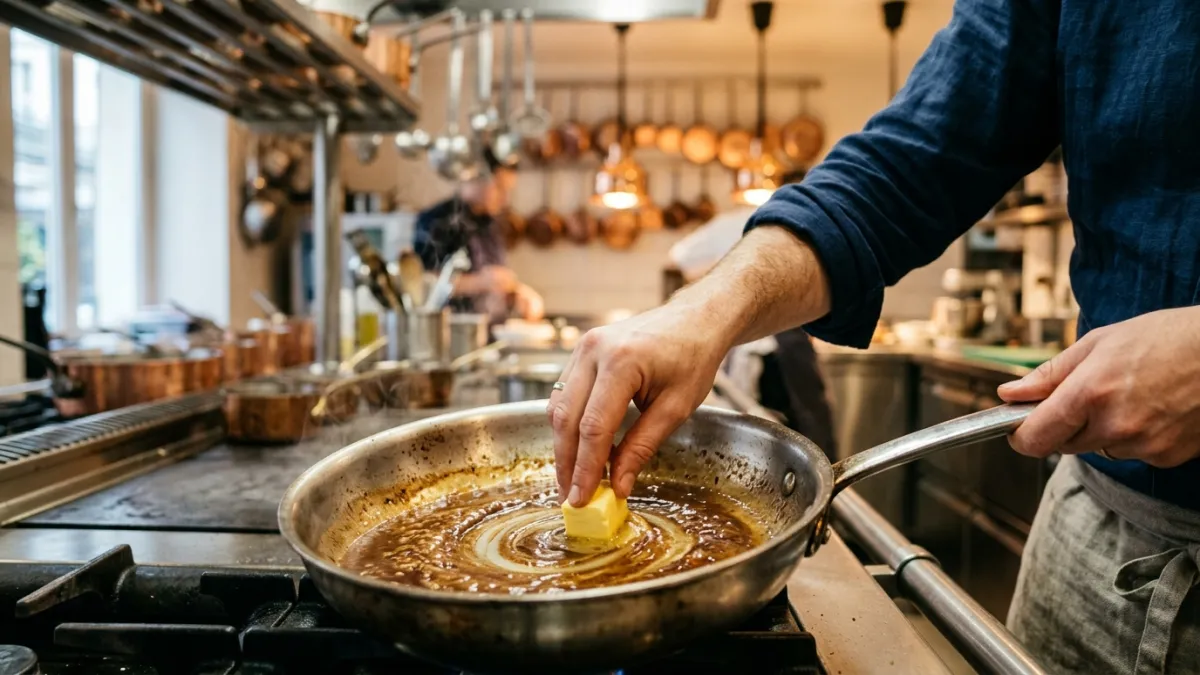
You did everything right. You ordered grilled fish and sautéed vegetables, the two safest-sounding items on the menu. What you didn’t see: ten seconds before plating, the chef swirled a knob of cold butter into the pan, off the heat, the way French chefs finish almost everything.
Monter au beurre (“to mount with butter”) is the French technique of whisking cold butter into a finished sauce or dish off the heat, adding gloss and body just before serving. Because it happens after cooking and appears nowhere on the menu, dishes that read as dairy-free routinely arrive with butter in them.
TL;DR: French chefs finish sauces, vegetables, and fish with butter by default, and menus never say so. Four of the five French mother sauces contain dairy. The law requires written allergen disclosure, but roughly 75% of small establishments ignore it. Say “allergie” (never “intolérance”), ask “il y a du beurre dedans ?”, and favor southern, olive-oil-based cooking.
This article is for informational purposes. Always consult your allergist and verify directly with kitchen staff. No guide can guarantee safety.
What Is Monter au Beurre?
Monter au beurre means whisking cubes of cold butter into a warm sauce, off the heat, until they emulsify. The butter never browns and never announces itself. It just makes the sauce glossier, thicker, and rounder. In classical French training this is not a flourish, it is the default final step for pan sauces, wine reductions, and vegetable finishes.
That timing is exactly what makes it dangerous. The butter enters the dish after cooking is done, so it survives in fully allergenic form, and it enters at a stage no menu describes. A pepper sauce is listed as “pepper, cognac, stock.” The butter that binds it was added in the last thirty seconds. According to a 2023 study in the Annals of Allergy, Asthma & Immunology, 50% of restaurant allergen incidents involve hidden allergens in sauces and stocks. Monter au beurre is the French version of that statistic.
Why Doesn’t the Menu Warn You About Butter?
Because in French cooking, butter isn’t an ingredient. It’s infrastructure. Menus list what makes a dish distinctive (the fish, the wine, the herbs), not the technique that holds it together. Nobody lists butter for the same reason nobody lists salt.
The structure runs deeper than finishing technique. Classical French sauces all descend from five “mother sauces,” and four of the five contain dairy. Every derivative inherits the allergen of its parent.
| Mother Sauce | Contains Dairy? | Why | Common Derivatives |
|---|---|---|---|
| Béchamel | Yes | Milk + butter roux | Mornay, soubise, croque monsieur filling |
| Velouté | Yes | Butter roux | Allemande, sauce vin blanc |
| Hollandaise | Yes | Pure butter emulsion | Béarnaise, choron, mousseline |
| Espagnole | Usually | Butter roux in most kitchens | Demi-glace, sauce Robert |
| Tomate | Often not | Olive-oil versions exist | Provençale, portugaise |
If a French dish comes with a sauce and the sauce isn’t tomato-based and Provençal, assume dairy until the kitchen confirms otherwise.
Which “Dairy-Free-Sounding” French Dishes Actually Contain Butter?
The dishes that cause reactions are rarely the obvious ones. Nobody with a milk allergy orders raclette. The problem is the menu items whose names signal nothing. Milk is the most common food allergy among US adults, affecting an estimated 1.9%, about 4.7 million people, according to a 2019 JAMA Network Open study. Most of them can read a menu. None of them can see into the pan.
| Dish | Sounds Like | What’s Actually In It |
|---|---|---|
| Légumes sautés | Vegetables in oil | Routinely finished with butter off-heat |
| Poisson grillé | Plain grilled fish | Beurre blanc or brown butter added by default |
| Sauce au poivre | Pepper + stock | Cream and/or butter whisked in at the end |
| Purée de pommes de terre | Mashed potatoes | Joël Robuchon’s famous recipe: 500g butter per 1kg potato |
| Sauce béarnaise | A regional sauce | Butter emulsion; the name signals nothing |
| Escargots à la bourguignonne | Snails | Each shell is filled with garlic-parsley butter |
| Soupe de poisson | Fish soup | Traditional service adds Gruyère croutons and rouille |
| Blanquette de veau | Veal stew | Butter roux + cream + egg-yolk liaison |
With roughly 33 million Americans living with at least one food allergy (FARE), this naming gap is not a niche problem.
Doesn’t French Law Require Restaurants to Disclose Allergens?
On paper, France has some of the strongest allergen law in the world. EU Regulation 1169/2011 mandates written disclosure of 14 allergens, including milk, for restaurant food. France went further: Décret 2015-447 requires the information to be visible to you without your having to ask, posted on the menu, near the counter, or in a binder.
Practice is another story. A UFC-Que Choisir investigation found that 75% of artisan merchants, the neighborhood restaurants, caterers, and bakeries you actually want to eat at, provided no allergen information despite the legal requirement. The DGCCRF, France’s consumer protection agency, inspected 7,779 establishments across 88 departments in 2016, but enforcement remains inconsistent.
The practical takeaway: you have a legal right to ask “Puis-je voir la liste des allergènes ?” (may I see the allergen list?), and citing that right usually gets a serious response. Just don’t expect the list to be waiting for you.
How Do You Order Dairy-Free in a French Restaurant?
Lead with the word “allergie.” French food culture is famously skeptical of vague intolerances, but a declared allergy is taken seriously, especially if you mention severity. Per FARE’s guidance, communicate with the kitchen, not just the server:
“Travelers with food allergies should carry translated allergy cards and verify ingredients directly with kitchen staff, not front-of-house servers.” — FARE (Food Allergy Research & Education)
| English | French | Rough Pronunciation |
|---|---|---|
| I have a severe milk allergy | J’ai une allergie sévère au lait | zhay oon ah-lehr-ZHEE seh-VEHR oh LEH |
| Is there butter in this? | Il y a du beurre dedans ? | eel ee AH doo BURR duh-DAHN |
| Without butter, please | Sans beurre, s’il vous plaît | SAHN BURR seel voo PLEH |
| Does this dish contain cream? | Est-ce que ce plat contient de la crème ? | ess-kuh suh PLAH kohn-TYEHN duh lah KREHM |
| May I see the allergen list? | Puis-je voir la liste des allergènes ? | pwee-zhuh VWAHR lah LEEST day zah-lehr-ZHEHN |
One cultural note: French chefs treat dishes as composed works, and substitution requests can land badly. You’ll have better luck choosing dishes that are naturally dairy-free than asking the kitchen to rebuild a sauce.
Which Menu Words Signal Hidden Dairy?
You can screen a French menu for dairy the way you’d screen a label, if you know which words carry the warning. These terms almost always mean butter, cream, or cheese is involved, even when no dairy ingredient is listed.
| Menu Term | Meaning | Dairy Signal |
|---|---|---|
| À la crème | In cream | Cream |
| Au gratin / gratiné | Browned crust | Cheese, often butter and breadcrumbs |
| Meunière | Floured, pan-fried in butter | Butter (plus flour) |
| Velouté | ”Velvety” sauce or soup | Butter roux |
| À la normande | Norman style | Cream, butter, often egg |
| Au beurre / beurre noisette | In butter / brown butter | Butter, explicitly |
| Liaison | Thickened finish | Egg yolk + cream |
| À la provençale | Provence style | Usually safe: olive oil, garlic, tomato |
Scanning for these terms is the single highest-leverage skill for a dairy-allergic traveler in France. It’s also the kind of pattern-matching an app can do faster than a jet-lagged human: Menu Decoder flags terms like meunière and gratiné against your allergy profile when you photograph a menu, though it can’t see what happens in the pan, so the “il y a du beurre dedans ?” conversation still has to happen.
Where in France Is Dairy Allergy Easiest?
Go south. France has an informal “butter line” (la ligne du beurre) running roughly along the Loire. North of it, butter and cream dominate: Normandy, Brittany, Burgundy, and Lyon are the hardest regions for a milk allergy. South of it, Provence and Languedoc cook in olive oil, and the southwest cooks in duck fat. The same dish can change fat entirely depending on region.
Southern menus are also where the reliably dairy-free classics live. Ratatouille, socca (chickpea flatbread from Nice), tapenade (note: contains anchovies), salade niçoise, and confit de canard are all traditionally made without dairy. Steak tartare is dairy-free in its classic form anywhere in the country. Every one of these still deserves the butter question, because kitchens improvise. According to FARE, about 30% of food-allergic travelers experience a reaction while traveling, and “traditionally safe” is not the same as “safe tonight, in this kitchen.”
For how France compares globally, see our ranking of the best and worst countries for dairy-allergic travelers. The invisible-technique problem isn’t unique to France either; Japan runs on hidden fish stock the same way France runs on butter, and our world tour of hidden allergen traps maps the pattern across cuisines.
Frequently Asked Questions
Is Butter Safe If You’re Dairy Allergic?
No. This is the most dangerous piece of misinformation in travel forums, where people regularly reassure dairy-allergic travelers that butter is “basically just fat.” Butter is roughly 80% fat, and it is genuinely low in lactose, which is why many lactose-intolerant people tolerate it. But a milk allergy is an immune reaction to milk proteins, casein and whey, and butter retains both. For someone with an IgE-mediated milk allergy, butter is fully allergenic, whether it’s melted into a sauce, browned into beurre noisette, or swirled in off-heat. If you’re lactose intolerant, French butter cooking may be manageable. If you’re milk-protein allergic, treat every French sauce as suspect until the kitchen confirms otherwise. Know which one you are before you travel, and if you’re unsure, ask your allergist, not a forum.
How Do You Ask If a Dish Contains Butter in French?
The direct question is “Il y a du beurre dedans ?” (eel ee AH doo BURR duh-DAHN), meaning “is there butter in it?” For a full declaration, say “J’ai une allergie sévère au lait” (I have a severe milk allergy), then name the specific ingredients: beurre (butter), crème (cream), lait (milk), fromage (cheese). The word choice matters. “Allergie” gets taken seriously in French kitchens; “intolérance” often doesn’t. If the allergy is severe, saying “ça peut être mortel” (it can be fatal) is culturally direct and effective. A written allergy card in French, shown to the server with a request to check with the chef, works better than spoken phrases, because the kitchen can read it during preparation rather than relying on a relayed conversation.
Which French Dishes Are Usually Dairy-Free?
The safest bets cluster in southern, olive-oil-based cooking: ratatouille (traditional Provençal versions), socca, tapenade (contains anchovies, so not fish-safe), and salade niçoise. Elsewhere, confit de canard is cooked in duck fat, steak tartare is raw beef with capers and mustard, and simple grilled meat or fish ordered “sans beurre” is usually accommodated. The trap is the finishing step: a kitchen may add butter to vegetables, fish, or even ratatouille out of habit, which is why “usually dairy-free” always needs the follow-up question. Avoid anything with gratin, crème, meunière, velouté, or normande in the name, and be suspicious of any sauce that isn’t explicitly tomato and olive oil based.
Do French Restaurants Have to Tell You About Allergens?
Legally, yes. EU Regulation 1169/2011 requires written allergen information for the 14 major allergens, milk included, in restaurants. France’s Décret 2015-447 goes further and requires that information to be visible without the customer asking, on the menu, posted nearby, or in a binder at the counter. In practice, compliance is poor: a UFC-Que Choisir investigation found 75% of artisan establishments provided no allergen information at all. So treat the law as a tool rather than a safety net. Asking “Puis-je voir la liste des allergènes ?” invokes a legal obligation, and most establishments respond seriously once they realize you know the rule. But your actual protection is the direct conversation with the kitchen, not the paperwork.
What Part of France Is Best for Dairy-Allergic Travelers?
Provence and the Mediterranean south. Southern French cooking is built on olive oil, garlic, tomato, and herbs, the “à la provençale” profile, which is the closest thing French cuisine has to a dairy-free default. Nice adds socca and salade niçoise; the broader south adds ratatouille, tapenade, and grilled fish that’s more likely to arrive with lemon and oil than beurre blanc. The hardest regions are north of the butter line: Normandy (cream and Camembert in everything), Brittany (salted butter is the regional identity), Lyon, and Burgundy. The southwest is a middle case, cooking in duck fat rather than butter, though cassoulet and confit country brings its own non-dairy hazards. If a dairy allergy is shaping your itinerary, plan more nights in the south.