
You walk into a Bangkok jay (Buddhist vegetarian) restaurant, figure “no meat, no problem,” and order the pad see ew. It arrives drenched in dark soy sauce with a block of tofu at the center. Two soy sources in the restaurant type travelers assume is a safe zone.
Thailand is one of the more manageable Asian countries for soy allergies because the cuisine’s umami backbone is nam pla (fish sauce, น้ำปลา), not soy sauce. Traditional curries, tom yum, som tam, and grilled meats are naturally soy-free. The main traps are stir-fries, tofu, most oyster sauce brands, and jay restaurants, which run on soy sauce and tofu by design.
TL;DR: Most stir-fries use soy sauce plus oyster sauce. Most curries and soups are soy-free because fish sauce is the base. Tofu is soy. Jay (Buddhist vegetarian) restaurants are dangerous, not safe, for soy allergies. Isan cuisine is the safest regional option. Watch for Rosdee seasoning powder. Thai FDA now mandates soy labeling on packaged food as of July 2024.
This article is for informational purposes only. If you have a soy allergy, consult your allergist before making dietary decisions based on this content. Restaurant situations vary, and no guide can guarantee safety.
Why Is Thailand One of the Easier Asian Countries for Soy Allergies?
The short answer is fish sauce. Nam pla (น้ำปลา) is fermented anchovy, salt, and occasionally sugar. No soy. It functions as the universal seasoning in Thai cooking the same way soy sauce does in Japanese, Chinese, and Korean cuisines. In Thailand, savory depth comes from fish sauce, tamarind, and chili paste. Soy sauce appears mainly in stir-fries as a Chinese-influenced addition, not a foundational element.
Standard Thai soy sauce (si-ew, ซีอิ๊ว) is brewed from roughly 50% soybean and 50% wheat, per Kikkoman production data, which applies to Thai brewing by the same process. Dishes that skip soy sauce tend to be both gluten-free and soy-free by default.
According to Bangkok Post 2024 clinical data, soy milk is one of Thailand’s five most common food allergens, alongside cow’s milk, eggs, wheat flour, and shellfish. Food allergy incidence in Thailand has increased 3 to 4 times over recent decades (Bangkok Post, 2024). Awareness is growing, but soy as a hidden ingredient is still not well understood by most Thai kitchen staff.
Which Thai Dishes Hide Soy You Wouldn’t Expect?
The most dangerous dishes aren’t obviously soy-heavy. They’re the everyday stir-fries that dominate Bangkok street food. According to a 2023 Annals of Allergy, Asthma & Immunology study, 50% of allergic reactions at restaurants involve hidden allergens in sauces, pastes, and preparations.
| Dish | Thai Script | Hidden Soy Source | Risk Level |
|---|---|---|---|
| Pad see ew | ผัดซีอิ๊ว | Light soy + dark soy + oyster sauce. Name means “fried with soy sauce” | Very High |
| Pad kra pao | ผัดกระเพรา | Soy sauce + dark soy + oyster sauce | Very High |
| Khao pad (fried rice) | ข้าวผัด | Fish sauce + soy sauce + often oyster sauce | High |
| Jay (vegetarian) dishes | เจ | Soy sauce replaces fish sauce; tofu as main protein | Very High |
| Pad thai | ผัดไทย | Restaurant versions add soy for color; tofu cubes are soy | Moderate-High |
| Khao soi | ข้าวซอย | Soy sauce in the broth; also wheat egg noodles | High |
| Satay sauce | น้ำจิ้มสะเต๊ะ | Often blended with soy sauce or sweet soy (si-ew wan) | Moderate |
Every Thai stir-fry wok station runs on three bottles: light soy sauce (si-ew khao, ซีอิ๊วขาว), dark soy sauce (si-ew dam, ซีอิ๊วดำ), and oyster sauce (nam man hoi, น้ำมันหอย). These sit within arm’s reach of every wok and go into virtually every order by default. Pad see ew (ผัดซีอิ๊ว) makes this explicit in its name. Pad kra pao (ผัดกระเพรา), Thailand’s most popular street food, uses soy sauce plus dark soy plus oyster sauce before anything else hits the wok. You can’t request a soy-free stir-fry at a street stall without removing the entire flavor architecture.
Pad thai occupies a special category. The traditional recipe is tamarind, fish sauce, and palm sugar, all soy-free. But the tofu cubes in pad thai are soy, and most restaurant versions add soy sauce for color. If pad thai matters to you, ask “mai sai tao hu, mai sai si-ew” (no tofu, no soy sauce) at a tourist-facing restaurant with trained staff. At a high-volume stall, wok residue from previous batches makes it hard to guarantee.
Which Thai Dishes Are Naturally Soy-Free?
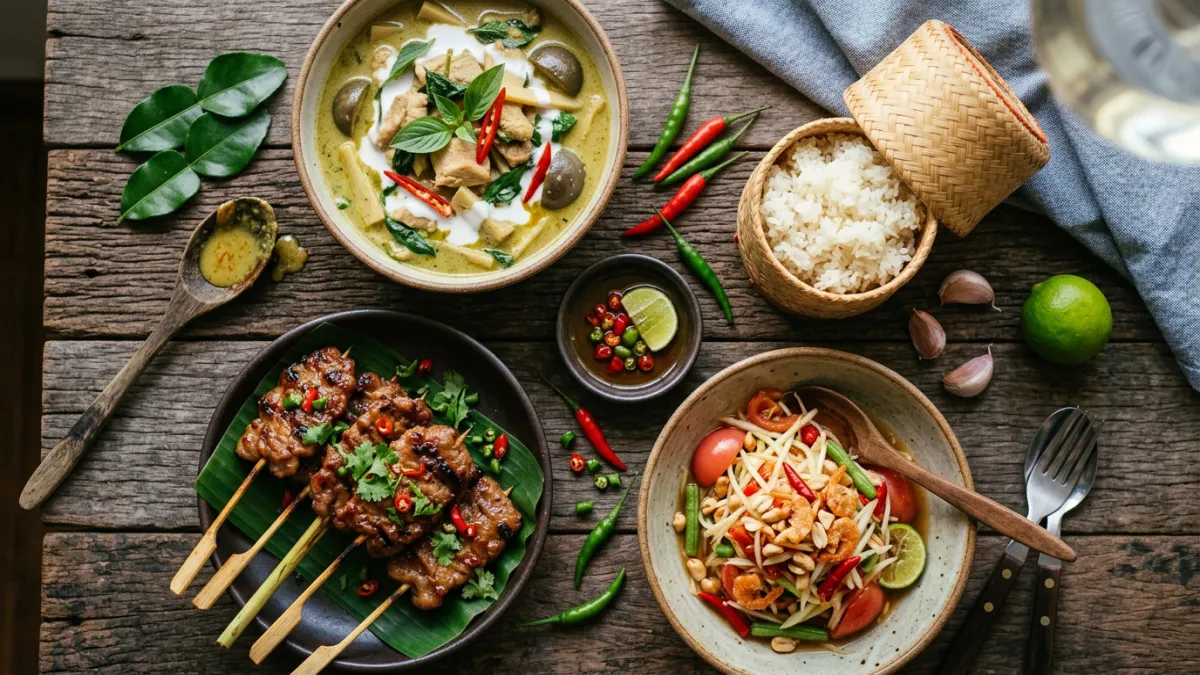
Plenty of Thai food is genuinely soy-free. Stick to dishes that use fish sauce as the primary seasoning and skip the stir-fry station. Traditional curries are the clearest example: coconut milk, chili paste, and fish sauce. No soy in the traditional recipe. A 2025 Tropical Diseases, Travel Medicine and Vaccines study found that 6.9 to 10% of travelers with food allergies experience a reaction abroad. Knowing the safe list before you arrive narrows that risk.
| Dish | Thai Script | Why It’s Usually Safe | Verify |
|---|---|---|---|
| Tom yum | ต้มยำ | Lemongrass + galangal + lime + fish sauce | No Rosdee added |
| Tom kha | ต้มข่า | Coconut + galangal + fish sauce | No soy in broth |
| Green / red curry | แกงเขียวหวาน / แกงแดง | Coconut milk + chili paste + fish sauce | Fresh paste, not jarred |
| Som tam | ส้มตำ | Papaya + fish sauce + lime + palm sugar | No soy dressing |
| Larb / laab | ลาบ | Minced meat + fish sauce + lime + toasted rice | Confirm no soy added |
| Grilled meats (moo ping / gai yang) | หมูปิ้ง / ไก่ย่าง | Fish sauce marinade | Confirm marinade |
| Sticky rice / mango sticky rice | ข้าวเหนียว / ข้าวเหนียวมะม่วง | Pure rice or rice + coconut cream | Nothing |
Restaurant-made curry pastes are soy-free. Some jarred supermarket pastes add soy protein. If the restaurant makes their own paste, you’re usually on solid ground.
Why Are Buddhist (Jay) Restaurants Actually Dangerous for Soy Allergies?
This is the most important inversion in Thai allergy travel. Jay food (เจ) is strict Buddhist vegetarian cuisine that excludes all animal products, including fish sauce. For travelers with shellfish or fish allergies, jay restaurants are one of the safest options in Thailand. For soy-allergic travelers, they’re among the most dangerous.
Jay cooking replaces fish sauce with soy sauce. Tofu, tempeh-style soy protein, and soy-based meat substitutes take the place of meat. Nearly every jay dish is built on soy. Pad see ew at a jay restaurant doubles the problem: soy sauce in the sauce, tofu as the protein.
This inverts the standard “vegetarian is safer” travel advice. During Thailand’s annual Vegetarian Festival (กินเจ, Gin Jay, typically October), yellow-flagged jay stalls multiply across the country. These stalls are identified by a yellow sign or flag with the red character เจ. For soy-allergic travelers, that symbol marks a spot to avoid, not a safe fallback. This is consistently the top unexpected trap flagged in r/FoodAllergies and r/ThailandTourism for soy-allergic visitors.
How Do Thai Regions Differ for Soy-Free Travelers?
Regional variation matters more than most guides admit. Isan (northeast Thailand) is dramatically safer than Bangkok or Chiang Mai. The cuisine predates Chinese culinary influence and is built on fermented fish, sticky rice, and grilled meats rather than stir-fries. Thailand welcomed over 35 million international visitors in 2024 (Tourism Authority of Thailand), and most travel allergy guides treat the whole country as one risk tier. For soy allergy, it isn’t.
| Region | Staple | Soy Risk | Safest Dishes |
|---|---|---|---|
| Isan (Northeast) | Sticky rice, grilled meats | Lowest | Larb, som tam, gai yang, moo ping, sticky rice |
| Southern (Phuket, Krabi) | Rice, coconut curry | Moderate | Fresh curries, grilled seafood |
| Central (Bangkok) | Jasmine rice | Higher | Curries, soups, grilled meats. Every stir-fry is a risk |
| Northern (Chiang Mai) | Sticky rice, egg noodles | Higher | Sai ua sausage, sticky rice. Avoid khao soi, ba mee |
Khao soi (ข้าวซอย), the Chiang Mai signature dish, uses soy sauce in the broth alongside wheat egg noodles. Ba mee noodle soups in northern shops are typically soy-based too. If you’re building a trip around soy-free eating, Isan works hardest in your favor.
How Do You Order Soy-Free in Thai?
Communicating a soy allergy in Thailand is harder than it sounds. Soy isn’t broadly recognized as an allergen by Thai kitchen staff. Use ingredient names directly, not the category. Critical distinction: “thua lueang” (ถั่วเหลือง) means soybean. “Thua lisong” (ถั่วลิสง) means peanut. They sound similar, and travelers routinely use the wrong card. Keep both written down and point to the right one.
| Phrase | Thai Script | Romanization |
|---|---|---|
| I’m allergic to soybean | ผม/ฉันแพ้ถั่วเหลือง | Phom/chan pae thua lueang |
| No soy sauce | ไม่ใส่ซีอิ๊ว | Mai sai si-ew |
| No tofu | ไม่ใส่เต้าหู้ | Mai sai tao hu |
| No oyster sauce | ไม่ใส่น้ำมันหอย | Mai sai nam man hoi |
| No Rosdee seasoning | ไม่ใส่รสดี | Mai sai Rosdee |
| Use fish sauce instead | ใส่น้ำปลาแทน | Sai nam pla thaen |
| If I eat soybean I will die | ถ้ากินถั่วเหลืองจะตาย | Tha gin thua lueang ja tai |
The “ja tai” phrase sounds extreme but communicates severity in a way “allergic” (pae, แพ้) alone doesn’t. Show the Thai script to the cook, not the server. Soy allergy affects roughly 0.4% of children and 0.3% of adults globally (Journal of Allergy and Clinical Immunology, Warren et al., 2020). A written card beats spoken Thai in a noisy kitchen, because tonal pronunciation errors in Thai are common and consequential.
“Travelers with food allergies should carry translated allergy cards and verify ingredients directly with kitchen staff, not front-of-house servers.” FARE (Food Allergy Research & Education)
What Thai Condiments and Packaged Foods Hide Soy?
The Thai condiment shelf contains more soy than menus reveal:
- Si-ew khao (ซีอิ๊วขาว): Light soy sauce. The base of most stir-fry sauces.
- Si-ew dam (ซีอิ๊วดำ): Dark soy sauce. Soy plus molasses, used for color in noodle dishes.
- Si-ew wan (ซีอิ๊วหวาน): Sweet soy sauce. In dipping sauces and satay marinades.
- Tao jiew (เต้าเจี้ยว): Fermented soybean paste, used in some central Thai dishes.
- Nam man hoi (น้ำมันหอย): Oyster sauce. Most Thai restaurant brands, including Megachef and Maekrua, add soy protein and soy sauce to the formulation. Competitors flag oyster sauce for shellfish only. For soy-allergic travelers, it’s both.
- Rosdee (รสดี): Seasoning powder dumped into street stir-fries by default. Often contains hydrolyzed soy protein. Ask for none.
- Thai sriracha (ศรีราชา): Some brands include soy. Brand-specific.
On packaged food, the situation improved in 2024. Thai FDA Notification No. 450 B.E. 2567, effective July 19, 2024, makes soybeans (ถั่วเหลือง) category 6 of 9 mandatory allergens on packaged food labels (Tilleke & Gibbins, 2024). Refined soybean oil, tocopherols, and phytosterols are exempt, and most soy-allergic patients tolerate refined soy oil without reaction. This makes 7-Eleven and grocery labels genuinely useful for the first time.
How Do You Handle Cross-Contamination in Thai Kitchens?
Thai kitchen cross-contamination is structural. Woks are wiped quickly between orders, not soaped. Soy sauce residue from the previous batch stays on the surface and carries into yours. Shared fryers handle tofu and soy-marinated proteins before your order arrives. The soy bottle sits on every stall counter and cooks reach for it by reflex.
A 2025 Tropical Diseases, Travel Medicine and Vaccines study found that 6.9 to 10% of travelers with food allergies experience a reaction abroad. Shared kitchen equipment is a core driver. Your structural defense: order from categories that don’t touch the stir-fry station. Curries, soups, grilled meats, and salads bypass the wok entirely. Hotel restaurants and tourist-area sit-down spots are more likely to accommodate a dedicated-pan request than a high-volume street stall.
Menu Decoder was built for this scenario. You photograph the Thai menu and it flags dishes that likely contain soy sauce, oyster sauce, or tofu based on your allergy profile. It’s not 100% accurate, since Thai kitchens improvise and off-menu sauces happen. Use it as a first-pass filter, then verify with the cook using the phrase card above. For managing soy and gluten together, the celiac Thai guide covers the overlap, since Thai soy sauce is roughly 50% wheat.
Frequently Asked Questions
Is Thai Curry Soy-Free?
Traditional Thai curry is usually soy-free. The base is coconut milk, chili paste, and fish sauce (nam pla, น้ำปลา). Fish sauce is fermented anchovy with no soy content. Traditional chili pastes for green, red, yellow, panang, and massaman curries are made from fresh herbs, dried chili, kapi (shrimp paste), and galangal. None of these contain soy.
The caveat is restaurant practice. Some kitchens add soy sauce to curry for extra depth. Commercial curry pastes from jars occasionally include soy protein as a stabilizer; freshly made pastes generally don’t. Ask “mai sai si-ew” (no soy sauce) when ordering, and confirm the paste source. At traditional restaurants that cook from scratch, curry is likely your safest soy-free option. It’s also the most frequently recommended dish in allergy travel communities because fish sauce fills the umami role that soy sauce plays in other Asian cuisines. For the full Thailand allergy picture, see the complete Thailand food allergy guide.
Does Thai Fish Sauce Contain Soy?
No. Nam pla (น้ำปลา) is fermented anchovy, salt, and sometimes a small amount of sugar. No soy in the ingredient list. This is the single most important fact for soy-allergic travelers in Thailand. Fish sauce is the universal seasoning: it goes into curries, soups, salads, marinades, and dipping sauces. Every dish built on fish sauce rather than soy sauce is soy-free at the seasoning level.
When you ask a Thai cook to make a dish “sai nam pla thaen” (use fish sauce instead), you’re asking them to default to their own traditional base. That’s a much easier ask than removing soy from a cuisine where soy is foundational. Soy allergy affects roughly 0.4% of children and 0.3% of adults globally (Journal of Allergy and Clinical Immunology, Warren et al., 2020). For that group, the fish sauce substitution opens up the majority of authentic Thai cooking. For how fish sauce and soy sauce compare in gluten terms, see the soy sauce and wheat deep dive.
Are Buddhist (Jay) Restaurants Safe for Soy Allergies?
No. Jay food (เจ) excludes all animal products, which means it excludes fish sauce. To replace fish sauce’s savory depth, jay cooking uses soy sauce. Tofu and soy-based protein substitutes replace meat. Nearly every jay dish is built on soy, making these restaurants among the most hazardous options for soy-allergic travelers, even though they’re one of the safest options for fish and shellfish allergies.
During Thailand’s Vegetarian Festival (กินเจ, usually October), thousands of yellow-flagged jay stalls open across the country and at 7-Eleven. These look like allergy-safe options. For soy allergy, every item is a risk. The identifying symbol is a yellow sign with the red character เจ. Memorize it so you can avoid it, not be drawn toward it. This inversion of the usual “vegetarian is safer” logic is consistently the top unexpected trap reported in soy-allergy travel threads.
How Do I Say “I Have a Soy Allergy” in Thai?
The core phrase is “phom pae thua lueang” (ผมแพ้ถั่วเหลือง) for male speakers, or “chan pae thua lueang” (ฉันแพ้ถั่วเหลือง) for female speakers. “Thua lueang” (ถั่วเหลือง) is the Thai word for soybean. Keep it distinct from “thua lisong” (ถั่วลิสง, peanut), which sounds similar and causes real ordering errors.
For severity, add “tha gin thua lueang ja tai” (ถ้ากินถั่วเหลืองจะตาย), meaning “if I eat soybean I will die.” Thai kitchen staff respond to this phrase where “allergic” alone may not land.
Show the Thai text to the cook, not the server. Include specific exclusions in your card: no soy sauce (ไม่ใส่ซีอิ๊ว), no tofu (ไม่ใส่เต้าหู้), no oyster sauce (ไม่ใส่น้ำมันหอย), no Rosdee (ไม่ใส่รสดี). A written card is more reliable than spoken Thai in a noisy kitchen. For the full phrase comparison and peanut versus soy naming breakdown, see the Thai peanut allergy guide.
Can I Eat Thai Street Food With a Soy Allergy?
Conditionally yes. Safe categories: grilled meats (moo ping, หมูปิ้ง; gai yang, ไก่ย่าง) with fish sauce marinades, som tam without a soy-sauce dressing, sticky rice (ข้าวเหนียว), fresh fruit, and tom yum or tom kha without Rosdee.
Unsafe: basically everything from the stir-fry wok. Pad see ew, pad kra pao, khao pad, pad thai with tofu, and any dish seasoned with Rosdee are all high-risk. The wok isn’t scrubbed between orders, so soy residue carries into yours. At high-volume night market stalls where orders take 90 seconds, there’s no realistic window for a cook to accommodate a full exclusion list. Choose Isan-style stalls (sticky rice, grilled meats, som tam) over central Thai stir-fry stalls. Menu Decoder can help you pre-screen a market menu before you reach the counter, then confirm those dishes with the cook using the Thai phrase card.