
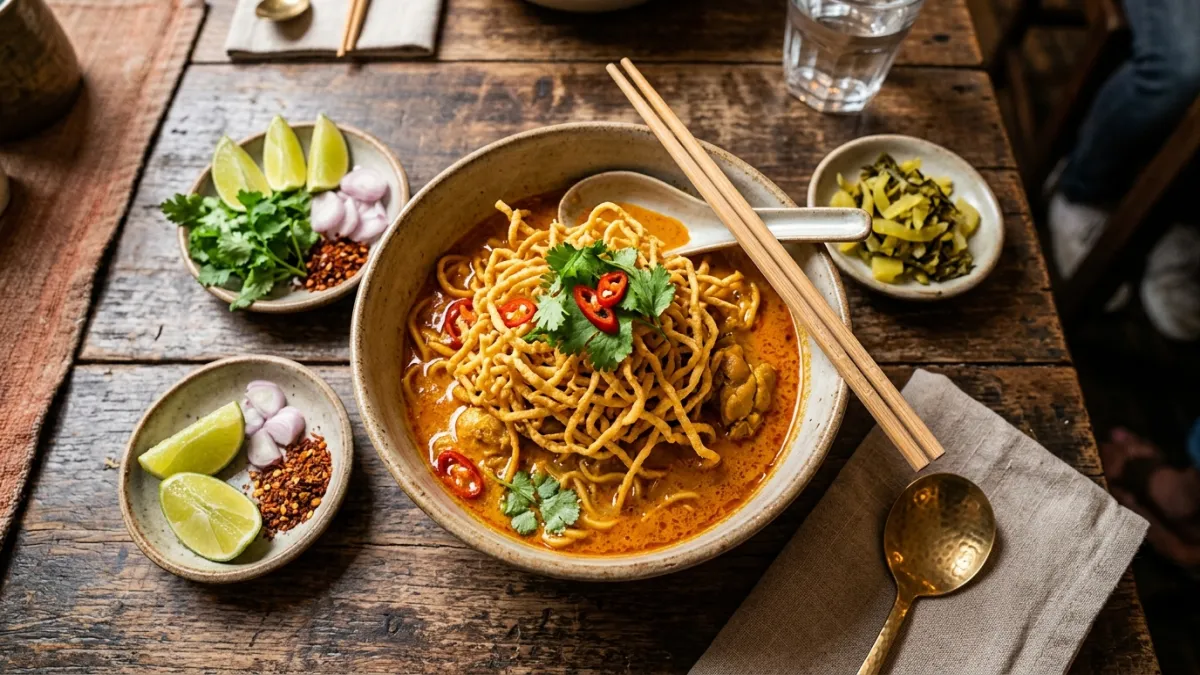
You land in Chiang Mai, open a menu, and see ข้าวซอย (khao soi), the northern signature dish. Thai food is rice-based, right? You order it. The bowl arrives with wheat egg noodles in the broth and crispy wheat noodles piled on top. Two wheat sources in the dish marketed as “Thailand’s regional must-try.”
Thai food is safer than Japanese or Chinese cuisine for celiacs because rice is the national staple and fish sauce (nam pla, น้ำปลา) is naturally gluten-free. But soy sauce, oyster sauce, khao soi noodles, fried spring rolls, and a wheat-based seasoning powder called Rosdee hide gluten in dishes that look safe.
TL;DR: Traditional Thai curries, rice noodles, grilled meats, and sticky rice are naturally gluten-free. The traps are soy sauce (roughly 50% wheat), oyster sauce (wheat thickener), khao soi (wheat egg noodles), and Rosdee (รสดี) seasoning powder. Fish sauce is gluten-free. Isan cuisine is safest. Jay (เจ) vegan restaurants and 7-Eleven are reliable fallbacks.
This article is for informational purposes only. If you have celiac disease, consult your doctor before making dietary decisions based on this content. Restaurant situations vary, and no guide can guarantee safety.
Why Is Thai Food Both Safer and More Dangerous Than You Think for Celiacs?
Thai cuisine is paradoxical for celiacs: the base is rice, the trap is in the sauces. Global celiac prevalence sits at roughly 1.4% by serology and 0.7% biopsy-confirmed, per Singh et al., Clinical Gastroenterology and Hepatology (2018). In Asia-Pacific the pooled seroprevalence is 1.2% across a 96,099-person low-risk cohort (Scientific Reports, 2021). Thailand itself is an outlier. A PMC review on Celiac Disease in Asia (PMC8130036, 2021) describes celiac prevalence in Thailand and Vietnam as “negligible” due to the rice-based diet.
That’s the upside. Jasmine rice (ข้าวหอมมะลิ), sticky rice (ข้าวเหนียว), and rice noodles dominate the cuisine. The downside: because domestic celiac disease is rare, restaurant awareness of gluten is also rare. Staff may treat “I can’t eat wheat” as a preference, not a medical condition. And the universal stir-fry base across Thailand is soy sauce plus oyster sauce, both of which hide wheat. For a cross-country view of where Thailand ranks, see our guide to the easiest and hardest countries for celiac travelers.
Which Thai Dishes Hide Gluten You Wouldn’t Expect?
The most dangerous Thai dishes aren’t the obvious noodle plates. They’re the stir-fries and curries built on wheat-containing sauces. A 2023 Annals of Allergy, Asthma & Immunology study found that 50% of allergic reactions at restaurants involve hidden allergens in sauces, pastes, and preparations. Thai cuisine is a case study.
| Dish | Thai Name | Hidden Gluten Source | Risk Level |
|---|---|---|---|
| Khao soi | ข้าวซอย | Wheat egg noodles + crispy wheat topping + soy sauce in broth | Very High |
| Pad see ew | ผัดซีอิ๊ว | Name literally means “fried with soy sauce.” Dark soy + light soy + oyster sauce | Very High |
| Pad kra pao | ผัดกระเพรา | Oyster sauce + soy sauce + dark soy | High |
| Fried spring rolls | ปอเปี๊ยะทอด | Wheat wrapper + shared fryer | High |
| Ba mee (yellow egg noodles) | บะหมี่ | Wheat noodles, often boiled in same pot as rice noodles | Very High |
| Street stir-fries with Rosdee | Various | รสดี seasoning powder contains wheat | Moderate to High |
Is Khao Soi Gluten-Free?
No. Khao soi (ข้าวซอย) is a double-wheat dish. The base is egg-wheat noodles simmered in a coconut curry broth, and the topping is a nest of deep-fried wheat noodles. Soy sauce is usually cooked into the broth as well. This is the iconic dish of Chiang Mai and northern Thailand, recommended to almost every first-time visitor. For celiacs, it’s a dish to memorize and refuse. No modification makes it safe. Ask for “gaeng gari” (yellow curry with rice) instead if you want the same flavor profile. This dish is the single biggest trap in celiac travel forums covering Chiang Mai.
What About Pad See Ew and Pad Kra Pao?
Both are wheat landmines. Pad see ew (ผัดซีอิ๊ว) translates directly to “fried with soy sauce.” The dish contains light soy (si-ew khao), dark soy (si-ew dam), and oyster sauce (nam man hoi), so three separate wheat vectors before you count any added Rosdee. Pad kra pao (ผัดกระเพรา), holy basil stir-fry, is Thailand’s most-ordered dish and uses oyster sauce plus dark soy as its base. The fried egg on top hides the sauce visually. You can ask the cook to make pad kra pao with only fish sauce and chili, no soy or oyster, but most street vendors will default to the standard recipe unless you escalate with an allergy card.
Which Thai Dishes Are Naturally Gluten-Free?
Plenty of Thai food is wheat-free at the ingredient level. The foundational staples are rice, coconut milk, fish sauce, and chili paste. Standard Thai soy sauce is roughly 50% wheat by dry weight (Kikkoman production data, which applies to Thai si-ew by the same brewing process). Fish sauce (nam pla, น้ำปลา) is anchovy plus salt plus sugar: no wheat. That single difference is why Thailand is easier than Japan for celiacs. For the full wheat-in-Asian-sauces breakdown, see our deep dive on soy sauce and wheat in Asian condiments.
| Dish | Thai Name | Why It’s Usually Safe | What to Verify |
|---|---|---|---|
| Sticky rice | ข้าวเหนียว | Pure glutinous rice, no wheat despite the name | Nothing |
| Som tam Thai | ส้มตำไทย | Papaya salad with fish sauce base | Ask for no soy sauce |
| Larb / laab | ลาบ | Minced meat salad, rice powder, fish sauce | No soy sauce added |
| Gai yang | ไก่ย่าง | Grilled chicken, marinade is fish sauce + lemongrass | Dipping sauce (often soy-free, verify) |
| Moo ping | หมูปิ้ง | Grilled pork skewers | Confirm no soy-based marinade |
| Green / red curry | แกงเขียวหวาน / แกงแดง | Coconut + chili paste + fish sauce | Confirm no soy added, check paste brand |
| Tom yum | ต้มยำ | Lemongrass + galangal + lime + fish sauce | No soy, no Rosdee |
| Rice noodle soups | ก๋วยเตี๋ยว | Sen lek / sen yai are rice-based | Shared-pot contamination with ba mee |
| Mango sticky rice | ข้าวเหนียวมะม่วง | Sticky rice + coconut cream + mango | None, this is the safest dessert |
Commercial curry pastes are a caveat. Some supermarket brands add wheat-flour stabilizers that traditional restaurant-made pastes don’t contain. If the restaurant makes their own paste, you’re usually fine. If they scoop from a jar, verify.
How Do Thai Regions Differ for Celiac Safety?
Regional variation matters more for celiacs than most country guides admit. Isan (northeastern Thailand) is dramatically safer than Chiang Mai. Central Thailand is a mixed bag. Southern Thailand is moderate. Thailand welcomed over 35 million international visitors in 2024 (Tourism Authority of Thailand), and most celiac travel guides treat the whole country as one risk tier.
| Region | Staple | Celiac Risk | Safest Dishes |
|---|---|---|---|
| Isan (Northeast) | Sticky rice | Lowest | Larb, som tam, gai yang, sai krok Isan, moo ping |
| Southern (Phuket, Krabi) | Rice, coconut curry | Moderate | Massaman, southern yellow curry, grilled seafood |
| Central (Bangkok) | Jasmine rice | Moderate | Curries, grilled meats, rice-noodle soups. Every stir-fry is a trap |
| Northern (Chiang Mai) | Sticky rice, egg noodles | Highest | Sai ua sausage, nam phrik num dip, sticky rice. Avoid khao soi |
Isan wins because the cuisine is rice-based, soy-sauce-light, and built around grilled meats and fermented fish sauce. Northern Thailand loses because khao soi is the regional icon and wheat noodles (ba mee) appear in more dishes. If you’re planning a trip around celiac safety, fly into Udon Thani or Khon Kaen, not Chiang Mai.
How Do You Order Gluten-Free in Thai?
Communication is the main safety tool. The word “gluten” (กลูเตน, klu-ten) is a loanword that Thai kitchen staff often don’t recognize. Use “khao sali” (ข้าวสาลี, wheat) instead. Severity escalators matter: a 2025 study in Tropical Diseases, Travel Medicine and Vaccines found that 6.9 to 10% of travelers with food allergies experience an allergic reaction abroad.
| Phrase | Thai Script | Romanization |
|---|---|---|
| I’m allergic to wheat | ผม/ฉันแพ้ข้าวสาลี | Phom/chan pae khao sali |
| No soy sauce | ไม่ใส่ซีอิ๊ว | Mai sai si-ew |
| No oyster sauce | ไม่ใส่น้ำมันหอย | Mai sai nam man hoi |
| No seasoning powder / Rosdee | ไม่ใส่ผงรส / รสดี | Mai sai phong rot / Rosdee |
| If I eat wheat I will die | ถ้ากินข้าวสาลีจะตาย | Tha gin khao sali ja tai |
The final phrase sounds dramatic but communicates severity in a way “allergic” doesn’t translate in Thai. Show the Thai text to the cook, not the server.
“Travelers with food allergies should carry translated allergy cards and verify ingredients directly with kitchen staff, not front-of-house servers.” - FARE (Food Allergy Research & Education)
Wheat flour ranks among Thailand’s top 5 most common food allergens, alongside cow’s milk, eggs, soy milk, and shellfish (Bangkok Post, 2024, citing Thai clinical data). Awareness is rising, but it’s not universal. If you’re juggling multiple allergies on the same trip, pair this guide with our complete Thailand food allergy guide and the Thai peanut allergy guide.
What Thai Condiments and Packaged Foods Contain Hidden Wheat?
The Thai pantry is stocked with soy-based sauces. Nearly every street stall uses some combination of the following:
- Si-ew khao (ซีอิ๊วขาว), light soy sauce: Brewed with wheat, same ratio as Japanese shoyu.
- Si-ew dam (ซีอิ๊วดำ), dark soy sauce: Wheat plus soy plus molasses, used for color in noodle dishes.
- Si-ew wan (ซีอิ๊วหวาน), sweet soy: Wheat-based, used in pad see ew and dipping sauces.
- Nam man hoi (น้ำมันหอย), oyster sauce: Contains wheat flour as a thickener in most Thai restaurant brands. Megachef and Lee Kum Kee sell gluten-free versions, but restaurants rarely stock them.
- Rosdee (รสดี) seasoning powder: Dumped by default into street stir-fries and soups. Composition varies by SKU. Often contains wheat-derived flavor enhancers. Verify with the allergy card.
Drinks: Singha, Chang, and Leo are barley-based lagers and are not celiac-safe. Thai whiskey (Mekhong, SangSom) is distilled from rice and molasses, so it’s potentially OK, though individual tolerance varies.
Packaged food got a real upgrade in 2024. Thai FDA Notification 450 B.E. 2567, effective July 19, 2024 (Thai Ministry of Public Health, summarized by Tilleke & Gibbins), mandates a “contains gluten-containing cereals” (ธัญพืชที่มีกลูเตน) declaration on packaged food. Full compliance for pre-existing stock is required by July 18, 2026. This makes 7-Eleven and grocery labels genuinely useful for the first time.
How Do You Handle Cross-Contamination in Thai Kitchens?
Thai kitchens run fast and clean poorly between orders. Woks often get a quick wipe, not a soap-and-water scrub, between dishes. Shared fryers handle battered spring rolls and tempura-style items next to plain chicken. Noodle soup vendors frequently boil rice noodles and ba mee (yellow wheat noodles) in the same broth, contaminating both. A 2023 Annals of Allergy, Asthma & Immunology study attributes 50% of restaurant-based allergic reactions to hidden allergens in sauces and shared preparations.
Your best structural fallback is Jay (เจ) vegan restaurants. Jay cuisine follows Buddhist dietary rules that exclude soy sauce-heavy recipes in many cases, skip oyster sauce entirely, and usually avoid Rosdee. Simpler ingredient lists means fewer places for wheat to hide. They’re identifiable by yellow-and-red flags with the Thai character เจ.
Menu Decoder was built partly for the Thai market. You photograph the Thai menu and it flags dishes that likely contain soy sauce, oyster sauce, or wheat noodles based on your celiac profile. It’s not 100% accurate because Thai restaurant kitchens improvise and some sauces are off-menu. Use it as a first-pass filter, then verify the shortlisted dishes with the cook using the Thai allergy card above.
7-Eleven is a reliable backup for rice meals and packaged snacks, now that gluten labeling is mandatory on pre-packaged food.
Frequently Asked Questions
Is Pad Thai Gluten-Free?
Traditional pad thai (ผัดไทย) is gluten-free on paper: rice noodles, tamarind paste, fish sauce, palm sugar, egg, and peanuts. No wheat in the original recipe. In practice, many Bangkok and tourist-area restaurants add soy sauce to boost color and umami. Hotel and food-court versions are more likely to use a premixed pad thai sauce that includes soy and oyster sauce. Beyond Celiac notes that pad thai “depends on the restaurant.” Ask: “mai sai si-ew, mai sai nam man hoi, mai sai Rosdee” (no soy, no oyster sauce, no seasoning powder). If the cook agrees and prepares it from scratch, pad thai is one of the more reliably safe Thai dishes. Wok cross-contamination is still a concern for highly sensitive celiacs.
Is Khao Soi Gluten-Free?
No. Khao soi (ข้าวซอย) is the single most-recommended dish in Chiang Mai and one of the worst possible orders for a celiac. The base is wheat-and-egg noodles in a coconut curry broth. On top is a tangle of crispy deep-fried wheat noodles. The broth itself often contains soy sauce. There is no variant of khao soi that is gluten-free. Some restaurants will swap the boiled noodles for rice noodles, but the crispy topping is intrinsic and the broth is already compromised. If you want the flavor profile, order “gaeng gari gai” (Thai yellow curry with chicken) over rice instead. Every major celiac travel forum covering Chiang Mai flags khao soi as the top accidental-exposure story. Memorize the Thai script (ข้าวซอย) so you can spot it on handwritten menus.
Does Thai Fish Sauce Contain Gluten?
No. Nam pla (น้ำปลา) is fermented anchovy, salt, and sometimes sugar. No wheat, no barley, no rye. This is the critical difference between Thai and Japanese cuisine for celiacs. In Japan, the default umami base is soy sauce, which is roughly 50% wheat. In Thailand, the default is fish sauce, which is naturally gluten-free. Fish sauce is the primary seasoning in green curry, red curry, tom yum, som tam, larb, and virtually every naturally-gluten-free Thai dish. When you ask a cook to make a dish “mai sai si-ew” (no soy sauce), they will almost always default to fish sauce for umami. That substitution is what makes Thailand workable for celiacs. Caveat: some dishes use both fish sauce and soy sauce, so “no soy sauce” still leaves naturally-GF fish sauce in place.
Is Thai Oyster Sauce Gluten-Free?
Almost never in restaurants. Standard Thai oyster sauce (nam man hoi, น้ำมันหอย) uses wheat flour as a thickener for its characteristic glossy consistency. Megachef and Lee Kum Kee both produce explicitly gluten-free oyster sauce for home cooks, but restaurants almost never stock the GF versions. Oyster sauce is the base of pad see ew, pad kra pao, and most stir-fried vegetable dishes. The escalation phrase is “mai sai nam man hoi” (no oyster sauce). Note this removes a flavor element the cook is used to adding, so the dish will taste lighter. For sensitive celiacs, assume any stir-fry contains oyster sauce unless a dedicated gluten-free kitchen confirms otherwise. A laminated Thai allergy card that specifically lists nam man hoi alongside si-ew and Rosdee is the most reliable way to communicate this constraint.
How Do I Say “I Have Celiac Disease” in Thai?
The word “celiac” doesn’t translate cleanly. Use “phom pae khao sali” (ผมแพ้ข้าวสาลี) for men or “chan pae khao sali” (ฉันแพ้ข้าวสาลี) for women, meaning “I’m allergic to wheat.” Celiac is not widely understood in Thailand (prevalence is described as “negligible” in the rice-based population, per the 2021 PMC review, PMC8130036), so framing it as a wheat allergy is more practical than explaining autoimmune conditions. For severity, add “tha gin khao sali ja tai” (ถ้ากินข้าวสาลีจะตาย), meaning “if I eat wheat I will die.” Thai staff take this phrase seriously. Show the Thai script directly to the cook, not the server. A printed allergy card that also lists soy sauce, oyster sauce, and Rosdee as forbidden ingredients works better than spoken phrases, because Thai is tonal and pronunciation errors are common.
Can I Eat Street Food in Thailand With Celiac?
Conditionally yes. Safe categories are grilled skewers with no soy marinade (moo ping, gai yang), som tam Thai (no soy), sticky rice, fresh fruit, and rice-noodle soups where you can watch the cook prepare your bowl separately. Unsafe categories are shared-wok stir-fries (pad see ew, pad kra pao, pad thai from high-volume stalls), anything fried in shared oil (spring rolls, tempura bananas), and Rosdee-laced soups. Wok cross-contamination is the biggest street-food risk, because the wok isn’t soaped between orders and soy sauce from the previous batch stays on the surface. Eat at stalls where you can see the cook work, and point to your Thai allergy card before they pick up the ladle. Isan-style stalls (grilled meats, sticky rice, som tam) are the safest sub-category.