
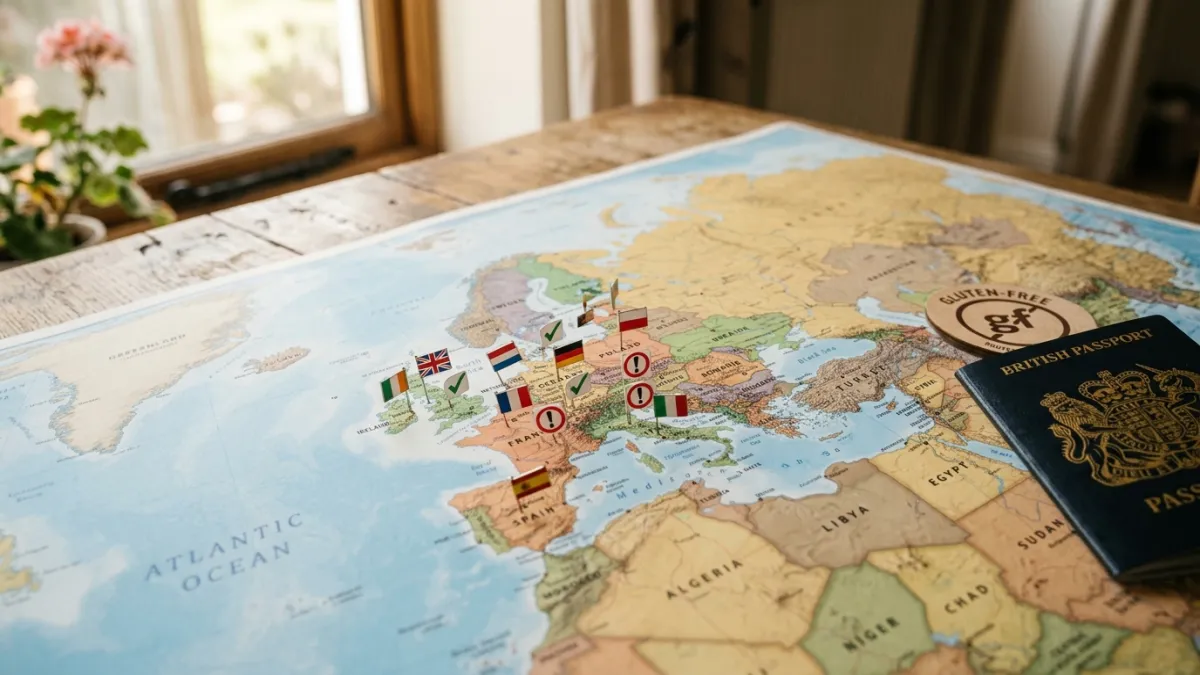
You’re comparing two trips. One destination has 4,000+ certified gluten-free restaurants and a government that pays celiacs 140 EUR/month for groceries. The other puts soy sauce brewed from 50% wheat on every table, and restaurants have zero legal obligation to tell you. The country you choose determines your safety more than any restaurant review.
Italy ranks #1 with a score of 9.1/10 across five weighted criteria. Japan ranks last at 1.7/10. Australia, Argentina, and Spain round out the top four. China and Korea join Japan at the bottom. For the narrative version covering seven countries in detail, see our guide to the easiest and hardest countries for celiac travelers.
TL;DR: Italy is #1 (4,000+ certified restaurants, EU allergen law, government stipends). Japan is last (soy sauce = 50% wheat, no restaurant disclosure law). Australia, Argentina, and Spain round out the top four. Thailand and Mexico rank mid-table thanks to rice and corn-based cuisines despite weak legal protections. Full 16-country ranking with transparent scoring below.
How Did We Score Each Country?
Each country is scored from 1 to 10 across five criteria, weighted by their impact on a celiac traveler’s daily experience. The final score is a weighted average rounded to the nearest whole number.
| Criterion | Weight | What It Measures |
|---|---|---|
| Base cuisine compatibility | 25% | How much of the everyday cuisine is naturally gluten-free |
| Labeling laws | 20% | Legal requirements for allergen disclosure in restaurants |
| GF infrastructure | 20% | Certified restaurants, GF product availability, celiac organizations |
| Hidden gluten severity | 20% | How dangerous and hard-to-detect the non-obvious gluten sources are |
| Cultural awareness | 15% | Staff understanding of celiac disease, national prevalence rates |
Celiac disease affects approximately 1.4% of the global population based on serological testing (Singh et al., 2018, Clinical Gastroenterology and Hepatology). But awareness and legal protections vary enormously. A country where 1 in 70 people has the condition but nobody knows it is structurally different from one where diagnosis triggers state-funded support. These criteria capture that difference.
Which Countries Rank Best and Worst for Celiac Travelers?
Italy leads the ranking by a wide margin. Australia and Argentina take second and third. Japan and China share the bottom. The full table shows each country’s score across all five criteria.
| Rank | Country | Cuisine (25%) | Laws (20%) | Infrastructure (20%) | Hidden Traps (20%) | Awareness (15%) | Total |
|---|---|---|---|---|---|---|---|
| 1 | Italy | 8 | 10 | 10 | 8 | 10 | 9.1 |
| 2 | Australia/NZ | 7 | 9 | 7 | 8 | 8 | 7.8 |
| 3 | Argentina | 7 | 8 | 8 | 7 | 8 | 7.6 |
| 4 | Spain | 7 | 9 | 7 | 7 | 7 | 7.4 |
| 5 | France | 4 | 9 | 6 | 4 | 6 | 5.7 |
| 6 | Brazil | 6 | 6 | 4 | 5 | 4 | 5.1 |
| 7 | Thailand | 9 | 3 | 3 | 5 | 4 | 5.0 |
| 8 | Mexico | 8 | 3 | 3 | 6 | 4 | 5.0 |
| 9 | Vietnam | 8 | 2 | 2 | 5 | 3 | 4.2 |
| 10 | West Africa | 8 | 1 | 1 | 5 | 2 | 3.7 |
| 11 | Peru/Colombia | 5 | 3 | 2 | 4 | 3 | 3.5 |
| 12 | India | 5 | 4 | 2 | 2 | 3 | 3.3 |
| 13 | Indonesia | 6 | 2 | 1 | 3 | 2 | 3.0 |
| 14 | Korea | 4 | 2 | 2 | 3 | 3 | 2.9 |
| 15 | China | 3 | 3 | 1 | 2 | 2 | 2.2 |
| 16 | Japan | 2 | 2 | 2 | 1 | 1 | 1.7 |
Scores reflect the celiac-specific experience, not overall food quality. Japan scores lowest despite having some of the world’s best cuisine because the structural barriers for celiacs are extreme.
Which Countries Are Easiest for Celiac Disease?
The top tier shares two traits: legal protections that make allergen disclosure mandatory, and cultural awareness that makes “I’m celiac” a meaningful statement rather than a blank stare.
Why Is Italy the Best Country in the World for Celiac Travelers?
Italy scores 10/10 because it has a complete national system built specifically for celiacs. The AIC certifies over 4,000 restaurants with annual on-site inspections. EU Regulation 1169/2011 requires written disclosure of 14 allergens in every restaurant. Diagnosed celiacs receive the “Bonus Celiachia,” a monthly stipend of 90-140 EUR for GF groceries (AIC / Italian Ministry of Health). A 2023 SIGENP study in Digestive and Liver Disease found estimated true celiac prevalence of 1.65% in Italian children, creating cultural pressure no other country has matched. Traps still exist: gnocchi alla Romana is 100% semolina, not potato. For the complete breakdown, see our deep dive on Italy for celiac travelers.
Is Argentina a Good Destination for Celiac Disease?
Argentina scores 8/10 thanks to Law 27,196, which requires restaurants to offer at least one GF option marked with the Sin TACC logo. ANMAT has approved over 30,000 GF foods and beverages (Celiac Disease Foundation). Health insurance must cover celiac detection, diagnosis, and GF product costs. “Sin TACC” (sin trigo, avena, cebada, centeno) is widely recognized in Buenos Aires, though infrastructure weakens in rural areas. Grilled beef (asado) and corn-dough empanadas are naturally GF. Watch for standard empanadas (wheat dough) and milanesa (breaded cutlets).
How Strict Is Australia About Gluten-Free Food?
Australia and New Zealand share the strictest gluten-free labeling standard in the world. FSANZ requires “no detectable gluten” for any product labeled GF, compared to the <20 ppm threshold used in the EU and US. Coeliac Australia maintains a well-organized certification network, and cultural awareness is high in urban areas. The main limitation compared to Italy is the lack of a restaurant-specific certification system with on-site inspections, but the legal standard itself is the highest anywhere.
Can You Eat Gluten-Free in Thailand?
Thailand scores well because the base cuisine is built on rice. Jasmine rice, sticky rice, and rice noodles are all naturally gluten-free. Curries made with coconut milk and curry paste, tom yum, grilled meats, som tam, and larb are usually safe. The traps are in the sauces: oyster sauce (nam man hoi) typically contains wheat flour and appears in pad kra pao, pad see ew, and most stir-fries. Thai soy sauce (si-ew) also contains wheat. There’s no formal GF infrastructure or restaurant labeling law. Say “กินข้าวสาลีไม่ได้” (Gin khao sali mai dai, “I can’t eat wheat”). A tool like Menu Decoder can help flag wheat-containing sauces when you photograph a Thai menu, though always confirm with the kitchen directly. For the complete guide, see eating safely in Thailand.
Is Mexico Safe for Celiac Travelers?
Mexico’s corn-based cuisine is a structural advantage. Corn tortillas, tamales, and masa-based dishes are naturally gluten-free. Central and southern Mexico default to corn tortillas, making everyday eating relatively straightforward. ACELMEX (Mexico’s celiac association) maintains some restaurant lists. The danger zones: northern Mexico and border regions default to flour tortillas (wheat). Jugo Maggi seasoning sauce contains wheat gluten and appears in many kitchens. Mole sauces may use bread as a thickener. Always specify “tortilla de maiz” and ask “Es solo maiz?” For the full guide, see eating safely in Mexico.
Which Countries Are Hardest for Celiac Disease?
The bottom tier shares a common problem: gluten is embedded in foundational ingredients and cooking techniques rather than in individual dishes you can simply avoid.
Why Is Japan the Hardest Country for Celiac Travelers?
Japan scores 2/10 because of one ingredient: soy sauce. Standard koikuchi shoyu is brewed from approximately 50% wheat and appears in every teriyaki, ponzu, marinade, and dipping sauce. Restaurants have zero legal obligation to disclose allergens. Celiac prevalence is roughly 0.05%, among the lowest globally (World Population Review), so the concept is culturally unfamiliar. Your lifeline is tamari, traditionally brewed with little or no wheat, but check labels. Say “小麦アレルギーがあります” (Komugi arerugii ga arimasu, “I have a wheat allergy”). “Celiac” will not register.
How Dangerous Is China for Celiac Disease?
China scores 2/10. Soy sauce is in virtually every stir-fry. Shaoxing wine contains wheat. Doubanjiang (chili bean paste) contains wheat. Northern China is roughly 80% wheat-based. “Celiac” (麸质) is borderline unknown. Frame it as “wheat flour allergy” (面粉过敏 / mianfen guomin). Southern Cantonese cuisine is somewhat easier due to its rice base. Labeling covers 8 mandatory allergens for packaged food, but restaurant enforcement is weak.
What Makes India a Hidden Trap for Celiacs?
India scores low because wheat hides where nobody expects it. Over 90% of commercial asafoetida (hing) powder contains 50-70% wheat flour by weight, and it’s in virtually every dal. Dishes that look like rice-and-lentils can contain hidden wheat through this single spice. The country splits geographically: South India is safer (dosa, idli, uttapam use fermented rice and urad dal batters). North India is a wheat belt with roti, naan, and paratha at every meal, plus tandoor cross-contamination. FSSAI introduced packaged food allergen rules in August 2025, but there’s no restaurant law. Ask “क्या इसमें गेहूँ या मैदा है?” (Kya ismein gehun ya maida hai?, “Does this contain wheat?”).
Is Korea Safe for Gluten-Free Travelers?
Korea scores 4/10 because wheat hides in the fermented pastes that define Korean cooking. Commercial gochujang, doenjang, and ganjang (soy sauce) commonly contain wheat. Fish cakes (eomuk) use wheat flour as a binder. Even tteokbokki rice cakes may contain wheat starch. There’s no mandatory restaurant allergen disclosure. Safe options: samgyetang (ginseng chicken soup), plain grilled meat with salt only, and steamed rice. Say “밀 알레르기가 있어요” (Mil allereugi-ga isseoyo, “I have a wheat allergy”). Korea’s hidden wheat in fermented condiments makes it riskier than its rice-eating reputation suggests.
What Should Every Celiac Traveler Pack?
Experienced celiac travelers carry a system, not just hope:
- Allergy cards in local languages. Printed, laminated, handed directly to the kitchen (not the server). Include your allergens in local script
- A tamari bottle for East Asia. Small, travel-sized, TSA-compliant. Your own verified wheat-free soy sauce eliminates the biggest variable in Japan
- Gluten-free hing for India. Rice-flour-based asafoetida from a specialty brand. Ask the kitchen to use yours instead
- The AIC app for Italy. About 5 EUR for two-week access, with a searchable map of 4,000+ certified GF restaurants
- A menu scanning tool. Apps like Menu Decoder can photograph foreign-language menus and flag gluten-containing items, including hidden sources like hing and soy sauce. Not a substitute for the kitchen conversation, but it narrows down which questions to ask
- Emergency medication. Prescribed antihistamines plus the local emergency number for each country
How Do You Say “I Have Celiac Disease” in 10 Languages?
In Europe and Latin America, “celiac disease” works. In East and Southeast Asia, “wheat allergy” is far more effective because celiac disease isn’t a recognized concept.
| Language | Most Effective Phrase | Script | Pronunciation |
|---|---|---|---|
| Italian | I am celiac | Sono celiaco/celiaca | SOH-noh cheh-LEE-ah-koh/kah |
| Spanish | I have celiac disease | Tengo enfermedad celiaca | TEN-goh en-fer-meh-DAHD seh-LEE-ah-kah |
| French | I am celiac | Je suis coeliaque | zhuh swee seh-LYAK |
| Japanese | I have a wheat allergy | 小麦アレルギーがあります | Komugi arerugii ga arimasu |
| Chinese (Mandarin) | I have a wheat flour allergy | 我对面粉过敏 | Wo dui mianfen guomin |
| Thai | I can’t eat wheat | กินข้าวสาลีไม่ได้ | Gin khao sali mai dai |
| Hindi | Does this contain wheat? | क्या इसमें गेहूँ या मैदा है? | Kya ismein gehun ya maida hai? |
| Korean | I have a wheat allergy | 밀 알레르기가 있어요 | Mil allereugi-ga isseoyo |
| Vietnamese | I can’t eat wheat | Toi khong an duoc lua mi | Toy kohng an duok lua mee |
| Indonesian | I can’t eat wheat | Saya tidak bisa makan gandum | SAH-yah TEE-dahk BEE-sah MAH-kahn GAHN-doom |
In East Asia, wheat is a recognized allergen category. Celiac disease and “gluten-free” are not.
Frequently Asked Questions
Which country is the absolute best for celiac travelers?
Italy, by a significant margin. It combines four pillars no other country offers together: EU-mandated allergen disclosure (Regulation 1169/2011), 4,000+ AIC-certified venues with annual inspections, a government stipend up to 140 EUR/month for GF groceries, and widespread pharmacy GF sections. With over 250,000 diagnosed celiacs, saying “Sono celiaco” triggers a trained response in most restaurants. Australia/New Zealand comes second (strictest labeling standard globally) and Argentina third (Law 27,196 requiring GF options).
Is Japan safe for celiac disease?
Japan is the hardest major destination, scoring 2/10. Standard soy sauce (koikuchi shoyu) is brewed from 50% wheat and appears in virtually every cooked dish. Restaurants have zero legal obligation to disclose allergens. Celiac prevalence is roughly 0.05%, so the concept is culturally unfamiliar. Safe options: sashimi without soy sauce, shioyaki (salt-grilled fish), plain rice, and yakitori with salt only. Bring your own tamari and say “wheat allergy” (小麦アレルギー), never “celiac.”
Can you eat gluten-free in Thailand?
Thailand scores 5.0/10 because the base cuisine is built on rice. Curries, tom yum, grilled meats, som tam, and larb are usually safe. The traps: oyster sauce contains wheat flour and appears in most stir-fries, and Thai soy sauce (si-ew) also contains wheat. There’s no formal GF certification, so you’re relying on the cuisine’s natural compatibility. Ask “ไม่ใส่ซีอิ๊ว” (mai sai si-ew, “no soy sauce”) and “ไม่ใส่น้ำมันหอย” (mai sai nam man hoi, “no oyster sauce”).
Is France hard for celiac travelers?
France scores 5/10. French cuisine is built on roux (flour + butter), the base for virtually every classic sauce. The saving factor is EU Regulation 1169/2011, which requires written allergen disclosure in every restaurant. Paris has a growing GF scene and the AFDIAG certifies venues, but options thin out considerably outside Paris. Buckwheat galettes in Brittany seem safe but are often cooked on shared griddles with wheat crepes. Say “Je suis coeliaque” (zhuh swee seh-LYAK).
What is the most dangerous hidden gluten source when traveling?
Soy sauce in East Asia is the most dangerous because it’s brewed from 50% wheat and is foundational to Japanese, Chinese, and Korean cooking. The most unexpected trap is asafoetida (hing) in India, where over 90% of commercial powder contains 50-70% wheat flour by weight. Oyster sauce in Thailand contains wheat flour as a thickener. According to a PMC study, 50% of allergic reactions in restaurants involve hidden allergens in sauces or dressings. The pattern: dangerous gluten hides in condiments, sauces, and spices, not main ingredients.
How do you say “I have celiac disease” in different languages?
It depends on the country. In Europe and Latin America, “celiac” is culturally recognized. In East and Southeast Asia, “wheat allergy” is far more effective. In Italy, “Sono celiaco/celiaca” triggers a trained protocol. In Japan, say “小麦アレルギーがあります” (wheat allergy). In Thailand, “กินข้าวสาลีไม่ได้” (I can’t eat wheat). See the full 10-language translation table above. Always carry printed cards in local script to hand directly to kitchen staff.
This guide is for informational purposes only and is not medical advice. Allergen information, restaurant protocols, and regulations can change. Always verify directly with restaurant staff and consult your doctor for guidance specific to your condition.